
The figures behind the concept
Expandable structures change what a single launch can deliver in pressurized volume, which is the quantity a commercial station sells. What they have yet to show is a human-rated, standalone habitat that deploys, holds pressure and survives debris at the scale Max Space proposes. Until the demonstrator flies, 350 cubic meters is a design target, and the number worth watching is a pressure hold in orbit.
What Max Space is proposing
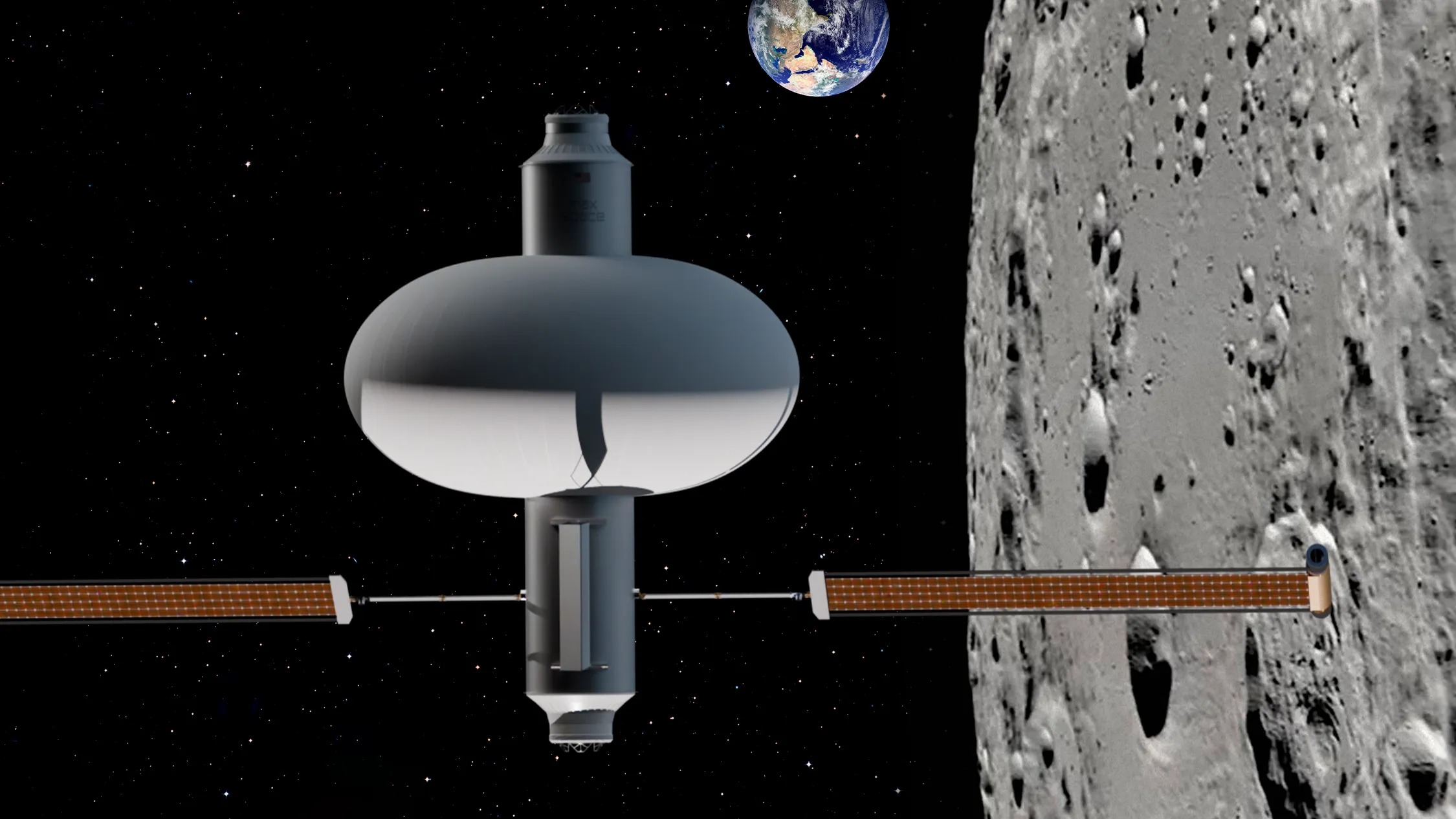
Thunderbird is a single-module commercial station that packs into a Falcon 9 fairing and expands once it reaches orbit.
Max Space is a Florida company near Kennedy Space Center, led by chief executive Saleem Miyan, with Aaron Kemmer as chairman and Maxim de Jong as chief technology officer. It emerged from stealth in April 2024 selling expandable module technology to other station builders. After NASA revised its commercial station approach in August 2025, replacing fixed-price awards with multiple smaller Space Act Agreements, the company decided to propose a station of its own.
The Thunderbird design was announced on 2025-12-17. The company lists 350 cubic meters of pressurized volume, a crew of four full time with up to eight for short stays, two docking ports, and more than 60 reconfigurable payload lockers. Its website states that an initial launch contract with SpaceX has been signed and that first crew flights are planned on Dragon, and it describes continuing NASA support through Space Act Agreements. Coverage of the announcement cites an expansion of about twenty times from the packed volume. Voyager Technologies has announced a multi-million-dollar strategic investment in the company.
The pitch is the phrase in the headline: space real estate. A station sells usable volume, and a structure that is compact at launch and large in orbit is a way of buying volume without buying the launches that rigid modules require.
Space real estate is priced by usable volume. Usable volume is only real once it has been expanded, pressurized and occupied.
Why launch arithmetic matters
The economic case rests on the ratio between the volume a fairing can carry and the volume the crew can use.
A rigid module is limited by the size of the vehicle that carries it, so a larger station means more launches and more assembly in orbit. Most station designs follow that path. An expandable module is limited at launch by the fairing and in orbit by its structure, and the ratio between the two is the gain. At the twenty-fold expansion cited in coverage, 350 cubic meters implies a packed volume of about 17.5 cubic meters, which is the firm's arithmetic and ignores any difference between structure, systems and usable interior. The demonstrator figures reported so far, roughly 2 cubic meters packed and 20 cubic meters expanded, imply a factor of ten, so the two ratios are worth reconciling.
The headline volume also needs a like-for-like comparison. NASA lists the ISS at about 388 cubic meters of habitable volume and about 1,005 cubic meters of pressurized volume. Max Space quotes Thunderbird as pressurized volume, so the fair comparison is roughly 35 percent of the ISS on the firm's arithmetic. Against the ISS habitable figure, 350 cubic meters reads as about 90 percent, but that is a different measure, and it is the one an unwary reader will reach for.
| Claim | On the record | Still open |
|---|---|---|
| One launch, 350 m³ | Announced 2025-12-17; website lists 350 cubic meters, Falcon 9 and 2029 | Deployment at this scale; mass; how much of the volume is usable |
| Expands reliably | An earlier expandable module on the ISS performed as expected in NASA’s early reporting | A standalone, human-rated habitat with its own life support |
| Protected against debris | The demonstrator is meant to test the debris protection system | Long-duration data; coverage conflicts on whether life support flies |
| Flies in 2029 | An early-2027 demonstrator slot; earlier reports gave 2025 and 2026 | Schedule margin against ISS retirement around 2030 |
| Funded and contracted | A multi-million-dollar Voyager investment; an initial SpaceX launch contract per the company | Capital for a full station; a NASA contract beyond Space Act Agreements |
What expandable structures have shown
The concept has flight heritage at small scale and none at the scale Max Space proposes.
The closest precedent is the expandable module berthed to the ISS in 2016, reported at about 16 cubic meters when expanded. NASA's early reporting said it performed as expected: radiation levels matched the rest of the station, its interior ran warmer than predicted but still cold, crews found no leaks in checks before entry, and inspections showed no sign of a large debris impact. That is real evidence that a soft-goods structure can expand, hold pressure and survive a period in orbit.
The gap to Thunderbird is the size and the job. At 350 cubic meters the structure is roughly 22 times larger on the firm's arithmetic, and it would stand alone, carry its own life support, and house a crew continuously. The precedent was an attached module visited from time to time. Each of those differences adds engineering risk that the earlier flight did not test.
Expandable structures trade a launch constraint for a deployment risk. The first number worth watching is a pressure hold.
Where it sits in the station race
NASA's restructured approach to commercial stations opened a lane for smaller proposals, and Thunderbird is one of them.
The ISS is expected to retire around 2030, and NASA plans to buy services from commercial stations, with no government-built successor planned. When it replaced fixed-price awards with multiple, smaller Space Act Agreements in August 2025, it made room for proposals of Thunderbird's size. Max Space works with NASA under such agreements, which allow technical collaboration without committing the agency to a procurement contract.
The schedule is the pressure point. The demonstrator has already moved from earlier reported dates to early 2027, and the full station targets 2029, roughly a year before the ISS is expected to retire. A further slip of either date would compress the interval in which Thunderbird could offer customers a continuous presence in orbit.
What to watch
A short list of observations will say more about Thunderbird than any rendering.
Mission Evolution deploys and holds pressure
Expansion to the planned volume and a pressure record over the length of the flight.
Shielding and radiation results
What the debris protection system and the interior environment record, and whether life-support hardware flies at all.
The NASA path
Whether Space Act Agreements turn into a service contract, since that determines the anchor customer for a station.
Financing and launch commitments
The size of the next funding round and the terms of the SpaceX launch agreement, which show how the market prices the risk.
Conclusion
Max Space has found a credible argument and a timely moment. Volume per launch is the quantity a commercial station sells, expandable structures raise it, and NASA's restructured approach made room for proposals of this shape. The firm's view is that the right posture is interest with a clear test: the claim of a 350 cubic meter station launched on a single Falcon 9 stays a design target until a demonstrator deploys, holds pressure and returns shielding data, and a human-rated version follows.
Volume is the product. Deployment is the proof. The first flight decides whether space real estate is a market or a rendering.
Sources: Max Space website (getmaxspace.com/thunderbird); trade and press coverage of the Thunderbird announcement of 2025-12-17, including SpaceNews, Gizmodo and Interesting Engineering; NASA reporting on the ISS expandable module and NASA ISS facts and figures. Figures described as the firm's arithmetic are illustrative derivations from publicly reported values and are not forecasts. Schedules are company targets and have moved before. For informational purposes only; not investment advice.