
The story in four numbers
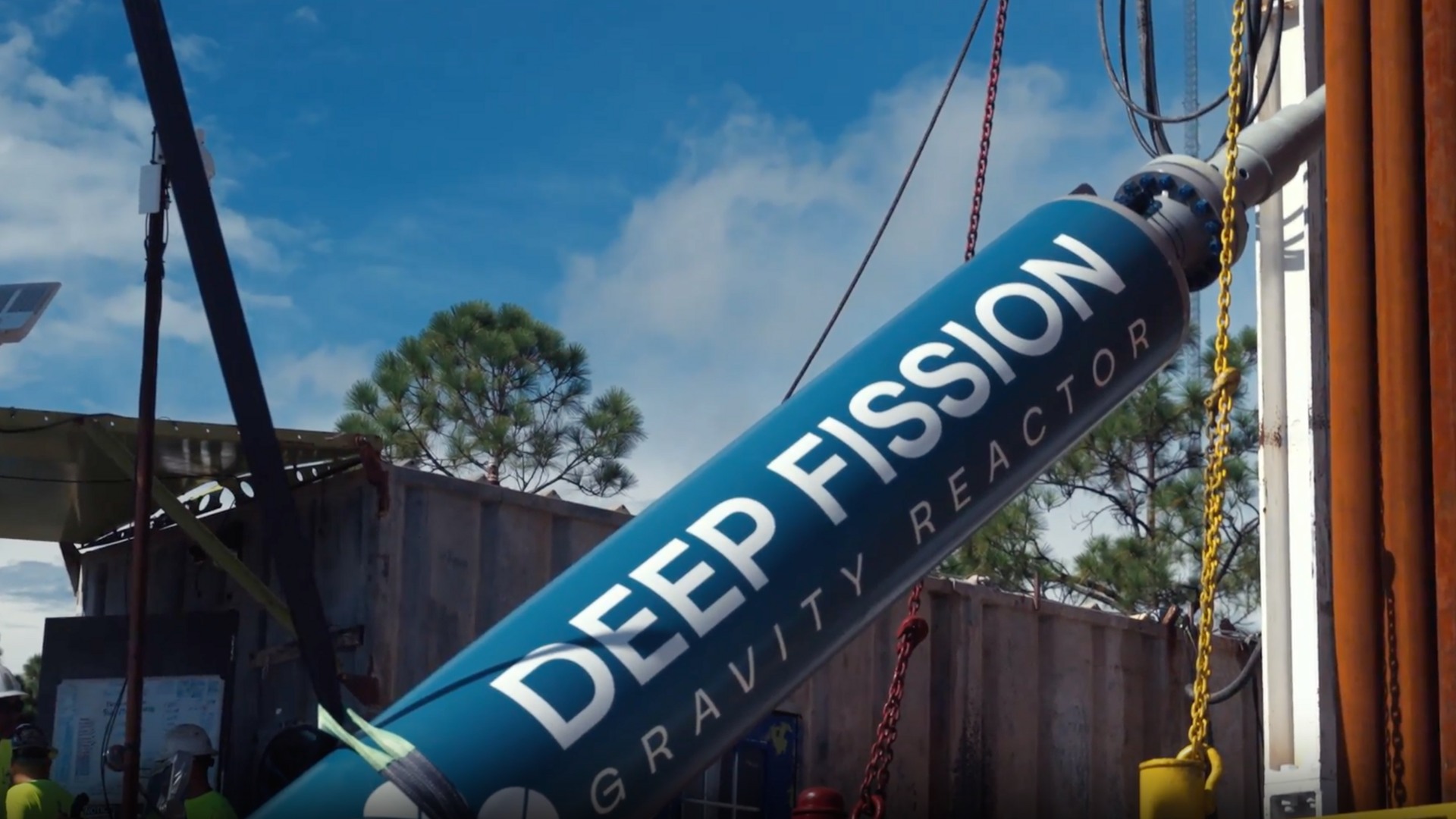
Deep Fission's proposition rests on a genuine and rather elegant piece of physics: a column of water roughly a mile deep exerts approximately 160 bar at its base, which is close enough to pressurised water reactor operating pressure that the borehole itself can serve the function a thick-walled forged pressure vessel serves at the surface, while the rock overburden performs the shielding and containment duty of a reinforced concrete dome. The firm regards this as the most interesting cost idea in advanced nuclear because it attacks the two line items that have historically been least tractable, namely the long-lead heavy forging and the containment structure, and because the engagement of an established deep-well drilling contractor is evidence that the enabling step is ordinary industrial practice rather than a technology that must first be invented. Our caution is that the saving is largest precisely where it is least available: the pressure-vessel argument scales with reactor size, and a unit small enough to fit down a thirty-inch hole was never going to need a four-hundred-tonne forging in the first place. Meanwhile the costs that dominate nuclear's economics in practice, which are licensing, security, staffing and the fixed overhead of an operating site, are indifferent to whether the reactor sits above the ground or a mile beneath it.
The partnership and what it actually tests
The engagement of Youngquist Brothers, a Florida-based contractor whose established business is large-diameter deep injection wells, is a more informative signal than a reactor design disclosure would have been, because it addresses the question on which the entire cost thesis depends: whether the borehole is a routine commercial procurement or a bespoke engineering programme.
Deep-well drilling at large diameter is a mature industry with known unit costs, known schedules, and a competitive contractor market. Injection wells of the kind Youngquist has built for Florida municipal wastewater disposal routinely reach several thousand feet at diameters measured in feet rather than inches, and they are permitted, cased, cemented and pressure-tested under established regulatory frameworks. If a reactor borehole is a variant of that work rather than a new discipline, then the cost of the hole is a quantity a contractor can bid, which is exactly the property a capital plan requires and exactly the property that most advanced nuclear concepts lack.
What the partnership tests, in our reading, is therefore narrower and more useful than the headline suggests. It is not a test of whether a reactor can operate at depth. It is a test of whether a borehole meeting the reactor's tolerances - diameter held over a mile of depth, verticality, casing integrity, and a completion that permits a module to be lowered and, critically, retrieved - can be produced repeatably at a price and on a schedule that a drilling contractor will underwrite. Those are ordinary questions in the drilling industry and they have ordinary answers, which is precisely why the firm treats this step as substantive rather than promotional.
The pressure trick and why it works
A pressurised water reactor is pressurised for one reason: to keep its coolant liquid at temperatures well above the atmospheric boiling point. Everything expensive about the primary circuit follows from the need to generate and contain that pressure mechanically. The borehole concept obtains the same pressure from gravity.
Water exerts pressure with depth according to the product of its density, gravitational acceleration and height, which at a nominal thousand kilograms per cubic metre gives roughly one bar for every ten metres of column. At approximately 1,600 metres the column therefore exerts on the order of 157 bar, and a conventional pressurised water reactor operates at roughly 155 bar. The correspondence is close enough to be the entire idea rather than a coincidence worth remarking on. At that pressure the saturation temperature of water is approximately 345 degrees Celsius, which leaves comfortable margin above a typical core outlet temperature near 325 degrees and keeps the coolant subcooled, which is the condition the pressure exists to maintain.
One qualification materially affects the design and deserves to be stated rather than buried. The arithmetic above assumes a cold column at nominal density. Hot water is substantially less dense, and a column at elevated temperature exerts correspondingly less pressure at the same depth, which means the working depth is a design variable that must be solved against the thermal profile of the installed system rather than a constant that can be read off a table. Our framework treats the one-mile figure as a design centre rather than a physical constant, and we would expect the as-built depth to move with the thermal-hydraulic detail.
A mile of water column exerts roughly the pressure a reactor vessel is engineered to contain. The wager is that the cheapest pressure vessel is the one you never build, and that the earth will hold what steel would otherwise have to.
| Depth | Hydrostatic pressure | Saturation temp. | Against a PWR at ~155 bar |
|---|---|---|---|
| 500 m | ~49 bar | ~262 °C | Far below |
| 1,000 m | ~98 bar | ~310 °C | Approaching |
| 1,600 m (~1 mile) | ~157 bar | ~345 °C | Essentially matched |
| 2,000 m | ~196 bar | ~366 °C | Above requirement |
What the hole replaces, and why the saving shrinks
The borehole substitutes for two of the most stubborn items in a nuclear plant's bill of materials. Our framework credits both, and then applies a correction that materially reduces the headline benefit and is, in our view, the single most underweighted feature of the concept.
The first substitution is the reactor pressure vessel. As we have written previously in the context of Chinese construction economics, the vessel is the most technically demanding single component in a conventional plant, a thick-walled forging of exceptional metallurgical purity produced by a small number of foundries worldwide, and its lead time has been a persistent constraint on Western projects. Removing it removes a supply chain dependency as much as a cost. The second substitution is the containment structure, the reinforced concrete building engineered to withstand internal pressurisation and external impact. A mile of rock performs that duty passively and is not on anyone's critical path.
The correction is this. Both savings scale with reactor size, and the borehole constrains reactor size severely. A thirty-inch bore admits a module of perhaps a couple of feet in working diameter, which bounds the core and therefore the output at figures in the low tens of megawatts electric. The forging that a fifteen-megawatt unit would otherwise require is not a four-hundred-tonne ring section from a constrained foundry; it is a comparatively modest piece of pressure-boundary steel that many fabricators could produce. The concept therefore claims its largest structural saving in precisely the size class where that saving is smallest in absolute terms. The pressure-vessel argument is strongest for the reactors that cannot fit down the hole.
What the hole cannot solve
Three constraints sit outside the physics of the concept, and in our framework they carry more weight in determining the outcome than the pressure argument that makes the idea attractive in the first place.
The first is retrieval. The design depends on lowering a reactor module to depth and raising it again for refuelling and maintenance, which converts an ordinary nuclear operation into a borehole operation. The drilling industry has a mature vocabulary for objects that become stuck downhole and a mature set of fishing techniques for recovering them, and those techniques assume the object is a drill string or a tool rather than an irradiated reactor core. A module that cannot be retrieved is not merely a commercial loss; it is a regulatory event with no operating precedent, and the firm expects the licensing process to concentrate heavily on demonstrating retrieval reliability rather than on the pressure argument, which is the easy part to defend.
The second is licensing. No regulator has licensed a power reactor in this configuration. The Nuclear Regulatory Commission's technology-inclusive framework and recent statutory direction to modernise advanced reactor review are real improvements in the process, but a first-of-a-kind configuration with novel siting, novel retrieval and a novel pressure boundary is a multi-year review under any framework. Our sensitivity on this concept is dominated by licensing duration rather than by construction cost, because every year of review is a year of capital carrying cost against no revenue.
The third is fixed operating cost per site. This is the constraint we regard as most consequential and least discussed. Nuclear economics in operation are dominated not by fuel, which is cheap, but by staffing, security and regulatory compliance, and those costs attach to a licensed operating site substantially independent of how much power that site produces. A conventional gigawatt station spreads that overhead across a gigawatt. A borehole field reaching a gigawatt through roughly sixty-seven fifteen-megawatt units spreads a comparable overhead across the same gigawatt only if the regulator permits one licence, one control room and one security force to cover the whole field. Whether it does is the central commercial question of the concept, and it is a regulatory determination rather than an engineering one.
Nuclear's cost problem is not only the capital stack. It is the fixed annual cost of a licensed, guarded, staffed site, and that number does not divide by the sixty-seven boreholes it takes to reach a gigawatt unless a regulator agrees that the field is one site.
Strong and largely physical. Gravity supplies the pressure, rock supplies the containment, and a competitive drilling market supplies the hole at a price that can be bid rather than estimated. Removing a long-lead forging from the critical path is worth more than its line-item cost because it removes a schedule dependency, and schedule is where Western nuclear capital has historically been destroyed.
Unresolved and regulatory rather than technical. If a borehole field is licensed, staffed and secured as a single site, the overhead divides across the field and the economics work. If each unit or small cluster carries its own compliance burden, the fixed cost per megawatt rises sharply with the very modularity that makes the concept deployable. Nothing in the physics settles this.
Why this is being financed now
The concept is not new in its physics and the firm does not read its current momentum as a scientific development. It is a demand-side development, and the demand is coming from a buyer that did not exist at this scale five years ago.
Large-scale computing infrastructure has produced a class of buyer with an unusual requirement profile: very large, very firm, very clean power, sited where the buyer wants it rather than where the grid happens to be strong, and available on a timeline measured in a few years rather than a decade. That combination is poorly served by existing options. Grid interconnection queues in several major markets have extended to multi-year waits. Renewables with storage struggle on the firmness requirement at the load factors these facilities run. Gas is fast and firm but carries an emissions profile that conflicts with the buyer's own public commitments. Conventional large nuclear satisfies firmness and emissions and fails comprehensively on timeline and unit size.
A borehole reactor field addresses that profile directly, at least on paper, because it is behind-the-meter by construction, because its modularity permits capacity to be added in increments matched to a facility's build-out rather than committed in a single gigawatt block, and because its siting flexibility is high wherever the geology is competent. The firm reads the announced commercial interest in this category as a rational response by buyers who are, in effect, paying an option premium for firm clean capacity that may be deliverable in the early 2030s. That is a legitimate reason for capital to be moving now and it does not require the technology to be proven, only for the option to be cheap relative to the alternative of having no firm clean power at all.
What this does not establish is cost. An announced agreement to take power at some future date is a demand signal, not a price discovery, and the firm would caution against reading letters of intent measured in gigawatts as evidence about the levelised cost of electricity from a technology that has not yet operated. The demand is real. The price is not yet known by anyone, including the vendor.
What would have to be true
Our framework reduces the investability of this concept to three determinations, none of which concerns the pressure argument that makes it interesting, and all of which are resolvable within a few years.
The first is whether a regulator will licence a borehole field as a single operating site with unified staffing, security and emergency planning. If yes, the fixed-cost denominator works and the modularity becomes an advantage. If no, the concept carries a per-unit compliance burden that the capital saving cannot offset, and the economics invert. The second is whether module retrieval can be demonstrated to a standard that satisfies a regulator under degraded conditions rather than nominal ones, because retrieval is the operation on which refuelling, maintenance and decommissioning all depend, and a concept that cannot reliably reverse its own installation is not a power plant but a disposal method. The third is whether the drilling cost holds at the tolerances the reactor requires, which is precisely what the contractor engagement is structured to find out and is the most likely of the three to return a favourable answer.
The firm's position is that the physics is real, the drilling is ordinary, the demand is genuine, and the outcome is nonetheless governed by a licensing question that no amount of engineering elegance will resolve. That is not a criticism of the concept. It is an observation about where the risk actually sits, and about the frequency with which advanced nuclear proposals are assessed on the sophistication of their reactor rather than on the durability of their operating licence.
The appeal of putting a reactor at the bottom of a borehole is that it converts an intractable manufacturing problem into a tractable drilling one, and the drilling industry is very good at drilling. The difficulty is that nuclear power has rarely been expensive because of the steel. It has been expensive because of the years, the lawyers, the guards and the staff, and none of those are cheaper a mile underground. If Deep Fission's regulator agrees that a field of boreholes is one site, this becomes a serious proposition. If not, the elegance of the pressure argument will have been beside the point.
A reactor a mile underground is still a grid connection and a construction schedule. The firm tests the first under energy siting and grid exposure, and the second with construction pipeline intelligence.
Sources: Interesting Engineering (interestingengineering.com), reporting by Neetika Walter on the Deep Fission and Youngquist Brothers drilling agreement; Deep Fission and Youngquist Brothers public statements; US Nuclear Regulatory Commission published guidance on advanced reactor licensing frameworks; standard steam tables for water saturation properties. All depth, pressure, output and borehole-count figures are the firm's own illustrative scenario arithmetic from publicly stated design parameters and are not a design specification or a forecast. This note is for informational purposes only and does not constitute investment advice.