
The story in four numbers
The Zoox federal approval is significant on two independent dimensions that compound each other commercially. The first is the regulatory dimension: a federal-level commercial approval for a steering-wheel-free vehicle establishes that NHTSA's AV exemption framework can produce operational commercial authority, not merely testing permits, and that the path from purpose-built AV development to paid commercial service at the federal level is traversable — a precedent that every other AV developer without a commercial approval will now benchmark against. The second is the competitive dimension: Zoox enters the commercial robotaxi market as the first purpose-built, bidirectional, steering-wheel-free vehicle in commercial service, competing against Waymo's substantially larger operational base and safety record in retrofitted Jaguar I-PACE vehicles — and the question of whether the purpose-built architecture's operational advantages (bidirectionality, interior design optimisation, no legacy human-control components) translate into a competitive differentiation that riders and regulators can observe in commercial service is the central variable in Zoox's market trajectory. The commercial approval does not resolve the question of Zoox's ability to scale its service to the fleet size, geographic coverage, and reliability standard that Waymo has established over its longer deployment history — but it removes the regulatory barrier that prevented that question from being posed in a commercial context, which is the prerequisite for every subsequent question about Zoox's commercial viability.
Why the federal distinction matters — NHTSA exemption versus state AV permits
The regulatory architecture governing autonomous vehicle deployment in the United States has developed primarily at the state level — California, Arizona, Nevada, Florida, and Texas have been the primary regulatory venues in which AV companies have obtained testing and commercial deployment permits, and the commercial services that Waymo, Cruise, and others have operated have been authorised under state DMV frameworks rather than federal motor vehicle safety standards. This state-level governance structure has allowed commercial deployment to proceed without resolving the fundamental tension between NHTSA's Federal Motor Vehicle Safety Standards — which are written for human-operated vehicles and include requirements for steering systems, pedals, and operator controls that a steering-wheel-free vehicle by definition does not have — and the operational reality of fully autonomous vehicles that are being commercially deployed on federal and state roadways. The federal regulatory framework for Automated Driving Systems has been in development at NHTSA for years, with successive guidance documents, advance notices of proposed rulemaking, and proposed regulatory frameworks that have not yet produced a comprehensive federal AV regulatory regime equivalent to what states have created through their own permitting processes. Into this gap, NHTSA has historically allowed AV deployment to proceed under a combination of state authority and voluntary safety reporting, with the formal federal exemption process — through which manufacturers can apply for relief from specific FMVSS requirements that would otherwise prohibit the vehicle's commercial use — serving as the mechanism for federal-level authorisation of vehicles that deviate from the safety standards' assumptions about human operation. The Zoox exemption represents NHTSA's formal endorsement, at the federal level, that a purpose-built vehicle without steering wheel, pedals, or conventional driver controls can operate commercially for paid passenger service — a determination that goes beyond the testing exemptions that have been the prior norm and that creates a federal commercial operating authority with implications for the AV regulatory framework that extend beyond Zoox's specific vehicle and service.
01 · What the Zoox approval is — exemption structure, vehicle architecture, and commercial scope
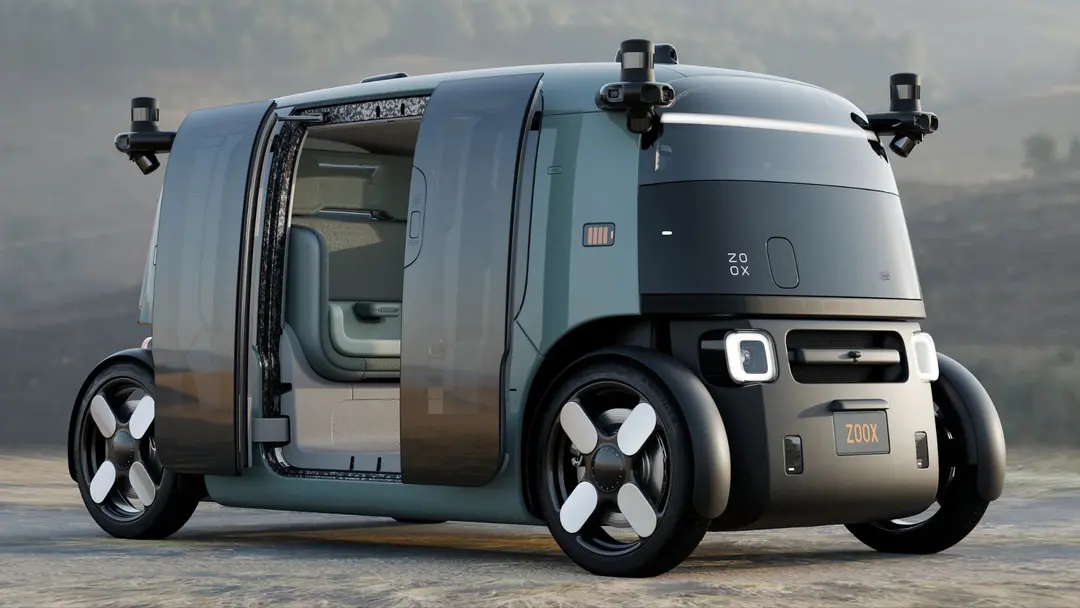
The Zoox approval is a NHTSA exemption from Federal Motor Vehicle Safety Standards that allows the Zoox vehicle — a purpose-built, bidirectional, four-passenger robotaxi with no steering wheel, no pedals, and no provision for manual operation — to operate commercially for paid ride-hailing service in defined geographic operational design domains.
The Zoox vehicle is architecturally distinct from the vehicles that have dominated prior commercial AV deployments. Waymo's Waymo One service operates in retrofitted Jaguar I-PACE electric SUVs — conventional vehicles modified with sensor arrays (LiDAR, cameras, radar), compute hardware, and the software stack that controls autonomous driving, but retaining the steering wheel, pedals, and driver controls that the original vehicle was designed with, even when those controls are not used during autonomous operation. The retrofit approach allows rapid fleet scaling by leveraging existing vehicle production capacity and safety certifications, but it inherits the design constraints of a human-operated vehicle — forward-facing seating, front-facing orientation, conventional interior layout — in a vehicle that no longer requires human operation. The Zoox vehicle, by contrast, is designed from the ground up as an autonomous vehicle: it is bidirectional (capable of moving in either direction without turning around, which provides operational advantages in dense urban environments), has inward-facing seating that allows passengers to face each other, has no front-back distinction in its exterior, and lacks any provision for human driving that would add weight, cost, and design constraints without contributing to the vehicle's autonomous operation. The operational design domain for the commercial approval — the specific geographic, environmental, and operational conditions under which the exemption applies — defines the scope of Zoox's commercial service at launch and the conditions under which the vehicle is authorised to carry paying passengers. ODD constraints typically specify a geographic service area (specific city or region), weather conditions (excluding severe weather, snow, ice, heavy rain below a visibility threshold), time-of-day restrictions, and maximum speed limits. The evolution of Zoox's ODD through demonstrated safety performance — progressively expanding the conditions under which the vehicle is authorised to operate as the safety record accumulates — is the mechanism through which the initial commercial approval expands toward the broader geographic and operational scope that a scaled robotaxi service requires.
The significance of the steering-wheel-free federal approval is not primarily operational — it is precedential. The first federal commercial authorisation for a purpose-built driverless vehicle defines what the approval process looks like, how long it takes, what safety documentation NHTSA requires, and what conditions it attaches to commercial operation. Every subsequent AV company applying for equivalent federal authority will navigate a process whose parameters were defined by the Zoox approval, making the regulatory precedent as commercially important as Zoox's own service launch.
02 · The competitive landscape — Waymo's operational lead versus Zoox's purpose-built advantage
The autonomous ride-hailing competitive landscape that Zoox enters with its federal commercial approval is defined primarily by Waymo's operational lead — millions of autonomous miles, hundreds of thousands of paid rides, and a commercial safety record that has made Waymo the reference standard for AV deployment — and by the absence of serious operating competition following Cruise's operational suspension in late 2023.
Waymo, Alphabet's autonomous vehicle subsidiary, has accumulated the most extensive commercial AV service record of any operator in the world, with commercial paid service in San Francisco (launched 2022), Phoenix (launched 2020 with safety drivers, fully driverless from 2023), Los Angeles (launched 2024), and expanding to Austin and other cities through its partnership with Uber. Waymo's competitive position rests on several accumulated advantages: a safety record that has, by the company's published data, demonstrated fewer severe crashes per vehicle mile than human-driven vehicles in comparable conditions; rider familiarity and brand recognition in its operational markets; a regulatory relationship with California, Arizona, and other state DMVs that has allowed progressive expansion of its operational domains; and the financial backing of Alphabet, which has continued to fund Waymo's development through periods where its commercial revenue has been insufficient to cover its operating costs. The critical commercial question for Waymo in 2025 is scaling economics: the company operates a relatively small fleet in a limited number of markets, and the path to the fleet size and market coverage that would make robotaxi economics transformatively competitive with conventional ride-hailing requires capital investment at a scale that has prompted Alphabet to raise external investment in Waymo — approximately $5 billion from external investors in the 2023-2024 period — rather than funding expansion entirely from Alphabet's balance sheet. Cruise's setback removed the most operationally proximate competitor to Waymo from the US market: General Motors' Cruise had operated commercial service in San Francisco before its suspension following the October 2023 pedestrian incident and subsequent regulatory revocation, and GM has significantly reduced its investment in and expectations for Cruise's commercial timeline, creating an opening in the competitive landscape that Zoox and Waymo are the primary remaining candidates to fill in major US urban markets. The competitive differentiation between Zoox and Waymo is most visible in the vehicle architecture: Zoox's purpose-built bidirectional design offers operational advantages in urban settings where the ability to exit without executing a three-point turn improves route efficiency and pickup/dropoff experience, and the interior design advantages of a no-controls, inward-facing configuration differentiate the passenger experience from Waymo's retrofitted vehicle. Whether these design advantages translate into competitive differentiation that riders value and that regulators reward with accelerated ODD expansion is the empirical question that Zoox's commercial service launch will begin to answer. The competitive landscape also includes Tesla's announced Robotaxi (the Cybercab), which has been presented as a future commercial autonomous ride-hailing product but has not received commercial regulatory approval, and the various AV companies that have entered partnership arrangements with incumbent mobility companies — Mobileye's autonomous vehicle programme, May Mobility's autonomous shuttle service — without achieving the federal commercial approval milestone that Zoox has now established.
| Company | Vehicle type | Federal approval | Commercial status | Operational markets | Competitive position |
|---|---|---|---|---|---|
| Waymo (Alphabet) | Retrofitted Jaguar I-PACE | State permits (CA, AZ, TX) | Commercial paid (fully driverless) | SF, Phoenix, LA, Austin | Market leader, safety record |
| Zoox (Amazon) | Purpose-built bidirectional | First federal commercial approval | Commercial paid (launching) | TBD (initial markets) | Challenger, purpose-built advantage |
| Cruise (General Motors) | Retrofitted Chevrolet Bolt | State permits (revoked 2023) | Suspended (Oct 2023 incident) | None (suspended) | Absent (rebuilding programme) |
| Tesla (Cybercab) | Purpose-built (announced) | None (not filed) | Pre-commercial (announced) | None | Future entrant (timeline uncertain) |
| May Mobility | Retrofitted shuttles | State permits (limited ODD) | Commercial (geofenced routes) | Multiple US cities (limited) | Niche (fixed-route shuttle) |
03 · The unit economics of driverless ride-hailing — what happens when driver cost goes to zero
The commercial rationale for autonomous vehicle development in ride-hailing has always been stated with clarity: driver compensation constitutes approximately 60 to 70 percent of the total cost per mile of conventional ride-hailing service, and removing that cost through automation creates the possibility of a ride-hailing economics model that is structurally profitable rather than structurally loss-making at the unit level.
Uber and Lyft's decade-plus of public market history as ride-hailing companies has produced a substantial body of evidence that conventional ride-hailing — at scale, with professional drivers, in competitive urban markets — does not generate consistent unit economics that support profitable operation at the market clearing price that riders and drivers will accept simultaneously. The driver compensation required to sustain adequate supply of quality drivers competes directly with the rider price point that maintains demand, and the company's take rate — the gross booking value retained after driver payment — has been persistently insufficient to cover the customer acquisition costs, insurance costs, regulatory costs, and technology platform costs that make up the rest of ride-hailing's cost structure. The structural resolution to this economics problem is autonomous operation: a vehicle that operates without a driver has a dramatically different cost structure, in which the variable cost per mile includes vehicle depreciation, energy (electricity), maintenance, insurance, software licensing, fleet management, and remote operations oversight, but not driver compensation. The firm's scenario-based modelling of this transition places the fully-loaded cost per autonomous mile — across all operating costs excluding customer acquisition — in the range of approximately $0.50 to $1.50 per mile at commercial fleet scale, compared to approximately $1.50 to $2.50 per mile for conventional ride-hailing including driver compensation at market rates. This cost structure differential is large enough to support either meaningful margin improvement at current ride-hailing prices or significant fare reduction that could expand the addressable market to trips that are currently priced above the demand curve at conventional ride-hailing economics. The sensitivity of this cost structure analysis to the key variables — vehicle utilisation rate (hours per day that the vehicle generates revenue), fleet maintenance cost as a function of autonomous system complexity, remote operations cost (the human oversight infrastructure required for commercially deployed AV fleets), and insurance cost in the absence of driver liability — determines whether the autonomous unit economics advantage is large or transformative, and those variables will only be reliably calibrated once fleets are operating at commercial scale across multiple cities and weather conditions. Amazon's position in this economic analysis benefits from one structural advantage that pure-play robotaxi companies do not have: the possibility of multi-use fleet utilisation that combines ride-hailing with delivery, combining passenger revenue with package delivery revenue in the same vehicle across different time periods. If the Zoox vehicle can be configured for both passenger transport during peak ride-hailing hours and last-mile delivery during off-peak hours — a possibility that Amazon's ownership of both Zoox and a major last-mile delivery operation makes logistically conceivable — the effective utilisation rate per vehicle improves substantially, changing the unit economics of the fleet investment even before the autonomous ride-hailing economics fully mature.
The economics of driverless ride-hailing are not a future hypothesis — they are a present calculation that becomes more precise with every commercial mile driven. The commercial approval is not the economic inflection point; it is the permission to begin generating the data that will produce the actual cost-per-mile figures that determine whether the autonomous unit economics advantage is $0.50 or $1.50 per mile, and whether that advantage is sufficient to build a sustainable ride-hailing business at the prices the market will bear.
04 · Amazon's strategic logic — why AV capability matters beyond the robotaxi market
Amazon's acquisition of Zoox in 2020 and its continued investment in the company's development through the commercial approval milestone reflects a strategic logic that extends beyond the robotaxi revenue opportunity to the broader role that autonomous vehicle capability plays in Amazon's logistics, consumer services, and platform businesses.
The most immediately legible strategic rationale is last-mile delivery autonomy: Amazon is one of the world's largest logistics operators, with a delivery network that handles hundreds of millions of packages per year across tens of thousands of delivery routes, and the labour cost of last-mile delivery — the final step from delivery station to customer door — is the primary cost driver in fulfilling Amazon Prime's free delivery promise at its current scale. An autonomous vehicle capability developed for the demanding technical requirements of urban ride-hailing — high sensor fidelity, precise localisation, real-time obstacle avoidance, and reliable performance across diverse weather and traffic conditions — is directly applicable to the technical requirements of autonomous last-mile delivery, and the sensor, software, and fleet management systems developed for Zoox's robotaxi platform are potential components of a future Amazon autonomous delivery system that would compete with or complement the Amazon Scout robot programme and the drone delivery programme that Amazon has also been developing. The second strategic dimension is Prime ecosystem integration: Amazon has historically expanded its Prime membership value proposition by adding services — streaming video, streaming music, grocery delivery, pharmacy — that increase Prime's perceived value and reduce customer churn. A ride-hailing service integrated into the Amazon app and Prime membership — offering Prime members priority access to Zoox robotaxis, Prime-priced ride-hailing, or a ride-hailing component in a bundled Prime tier — follows the pattern of Prime ecosystem expansion in a high-frequency consumer services category (transportation) where Amazon currently has no revenue. The frequency of transportation use relative to other Prime services makes it an attractive addition to the membership bundle, and the data that ride-hailing generates — origin and destination patterns, consumer behaviour, time-of-day demand curves — is complementary to the consumer behaviour data that Amazon already processes through its e-commerce and entertainment platforms. The third dimension is competitive positioning against Waymo-Uber and Waymo-Lyft partnerships: Waymo's commercial partnerships with Uber and Lyft — which route Waymo rides through the Uber and Lyft apps in operational markets — integrate Waymo's AV capability into Amazon's primary competitors in specific services (Uber Eats competes with Amazon delivery, Lyft's corporate ride programmes compete with Amazon's business services). Zoox's commercial robotaxi service, operated directly by Amazon or through Amazon's own consumer platform, would give Amazon a direct competitive position in mobility services that its current infrastructure does not provide.
The near-term period is defined by Zoox's execution on its commercial service launch — deploying paid rides in its initial operational design domain, accumulating the safety record that is the prerequisite for ODD expansion, and establishing the consumer-facing brand and ride quality that will determine whether the Zoox service develops rider loyalty or remains a novelty. Waymo's competitive response to the Zoox commercial launch — accelerating its own expansion into new markets, deepening its Uber and Lyft integrations, or pursuing its own path toward federal-level approval that would give it equivalent commercial authority without the state-permit limitations it currently operates under — is the competitive variable most likely to define the short-term AV market structure. The commercial service launch also generates the first commercial unit economics data for Zoox — cost per mile, utilisation rate, remote operations overhead, maintenance cost per vehicle — that will determine whether the AV economics thesis is confirmed or revised at actual commercial operating conditions rather than in investor presentations.
The longer-horizon commercial opportunity for Zoox is the integration of its autonomous vehicle capability into Amazon's broader logistics and consumer services platform — a strategic opportunity that is uniquely available to Zoox as an Amazon subsidiary and that is structurally unavailable to independent AV companies that lack Amazon's logistics infrastructure, consumer data, and platform reach. The realisation of this opportunity requires Zoox's autonomous system to achieve the reliability and operational scale that Amazon's logistics standards require — a higher bar than the initial commercial ride-hailing service — and the development of vehicle configurations and fleet management systems that can support both passenger transport and package delivery use cases within the same fleet. The timing of Amazon's potential Prime mobility integration is uncertain and will depend on how rapidly Zoox's commercial service matures into a product with the reliability, geographic coverage, and consumer experience quality that Amazon would associate with a Prime benefit, a standard that typically requires several years of commercial refinement to achieve.
What the Zoox approval changes in the autonomous mobility investment thesis
The Zoox federal approval is a regulatory milestone of the type that restructures the investment narrative around a technology transition without itself resolving the commercial uncertainties that determine investment outcomes. The milestone confirms that the US regulatory pathway for purpose-built, steering-wheel-free commercial AV deployment is open — a question that the absence of prior federal commercial approvals for such vehicles had left legitimately open — and it establishes Amazon as a direct commercial participant in the autonomous ride-hailing market rather than a strategic investor watching from the sideline. These confirmations reduce a specific category of regulatory and strategic risk that had been a legitimate uncertainty in the AV investment thesis, particularly for investors who had assigned non-trivial probability to the scenario in which the US federal AV regulatory framework remained too fragmented or too cautious to support commercial purpose-built AV deployment within a relevant investment horizon.
The commercial uncertainties that remain — operational reliability at scale, fleet economics at commercial utilisation rates, consumer adoption in competitive markets, and the unit economics advantage of autonomous operation at the prices the market will sustain — are not resolved by the approval, and they represent the variables that will determine whether the investment thesis is confirmed or whether autonomous ride-hailing proves, as conventional ride-hailing has, to be a high-revenue but structurally difficult-to-profit business whose cost structure advantages from removing the driver are offset by the capital cost of the autonomous system and the operating cost of the remote oversight and fleet maintenance infrastructure that commercial AV deployment requires. The firm's framework treats the Zoox approval as a necessary but not sufficient condition for the AV investment thesis — necessary because commercial operating authority at the federal level is the prerequisite for everything that follows, and not sufficient because the operational performance and commercial economics that follow determine whether the regulatory milestone leads to a commercially viable autonomous mobility business or to a well-funded demonstration that the vehicle works without yet demonstrating that the business works.
The Zoox approval matters most not to Zoox — whose path from commercial launch to scaled profitable service is measured in years of operational work that the approval merely enables — but to every other AV company that has been watching the federal regulatory framework as the barrier between their technology and their commercial market. The first federal commercial approval for a steering-wheel-free vehicle is, in the regulatory landscape, what Waymo's first driverless ride was in the operational landscape: a proof of concept that the system works, followed by the much longer and harder work of proving that it scales.
Sources: Interesting Engineering (interestingengineering.com) — source article; NHTSA AV exemption database and Automated Driving Systems regulatory documentation; Waymo published safety reports and investor disclosures; Alphabet Waymo external investment disclosures (SEC filings); GM Cruise regulatory filings and published incident investigation; Amazon Zoox published programme communications; Uber Technologies and Lyft investor disclosures and Waymo partnership announcements; Tesla published Cybercab product announcements; McKinsey Global Institute autonomous vehicle market analysis; KPMG Autonomous Vehicles Readiness Index; California DMV autonomous vehicle deployment permits database; IIHS autonomous vehicle safety research publications. This note is for informational purposes only and does not constitute investment advice.