The proposition in four numbers
The land we are losing, and the gap we have to close
The global food system is built on an assumption that is quietly failing: that soil is a stable resource, and that the land which grew crops last century will grow them this century and the next. Desertification and soil degradation are advancing across multiple continents, driven by a combination of unsustainable agricultural practices, deforestation, and a climate that is making arid regions hotter and drier faster than natural recovery processes can compensate. More than two billion hectares of once-productive land has been degraded, an area twice the size of China, and the United Nations projection is that, by 2030, the planet will need an additional 300 million hectares of productive farmland to feed a population approaching ten billion.
The Green Revolution of the 1960s closed an earlier food gap by making existing farmland more productive, better seeds, more fertiliser, larger irrigation systems. The next revolution may need to do something different: create farmland that does not currently exist, by transforming the degraded billion-hectare inventory that the previous century left behind. Desert Control's Liquid Nanoclay (LNC) is the most credible candidate technology we have seen for that thesis: a patented suspension of clay particles broken down to 1.5 nanometres, sprayable through conventional irrigation infrastructure, transforming sandy soil into a water-retaining, nutrient-holding growing medium in seven hours per application. The science is real, the field trial evidence is consistent, and the company is now generating commercial revenues across three distinct markets while operating with the financial discipline appropriate to an early-stage listed business that has not yet reached profitability.
Farmers have been mixing clay into sandy soil for thousands of years. Desert Control's insight was that the reason it worked poorly at scale was particle size, and that nanotechnology could solve that specific problem without changing anything else about the underlying chemistry.
How Liquid Nanoclay works, clay, water, and the nanoscale
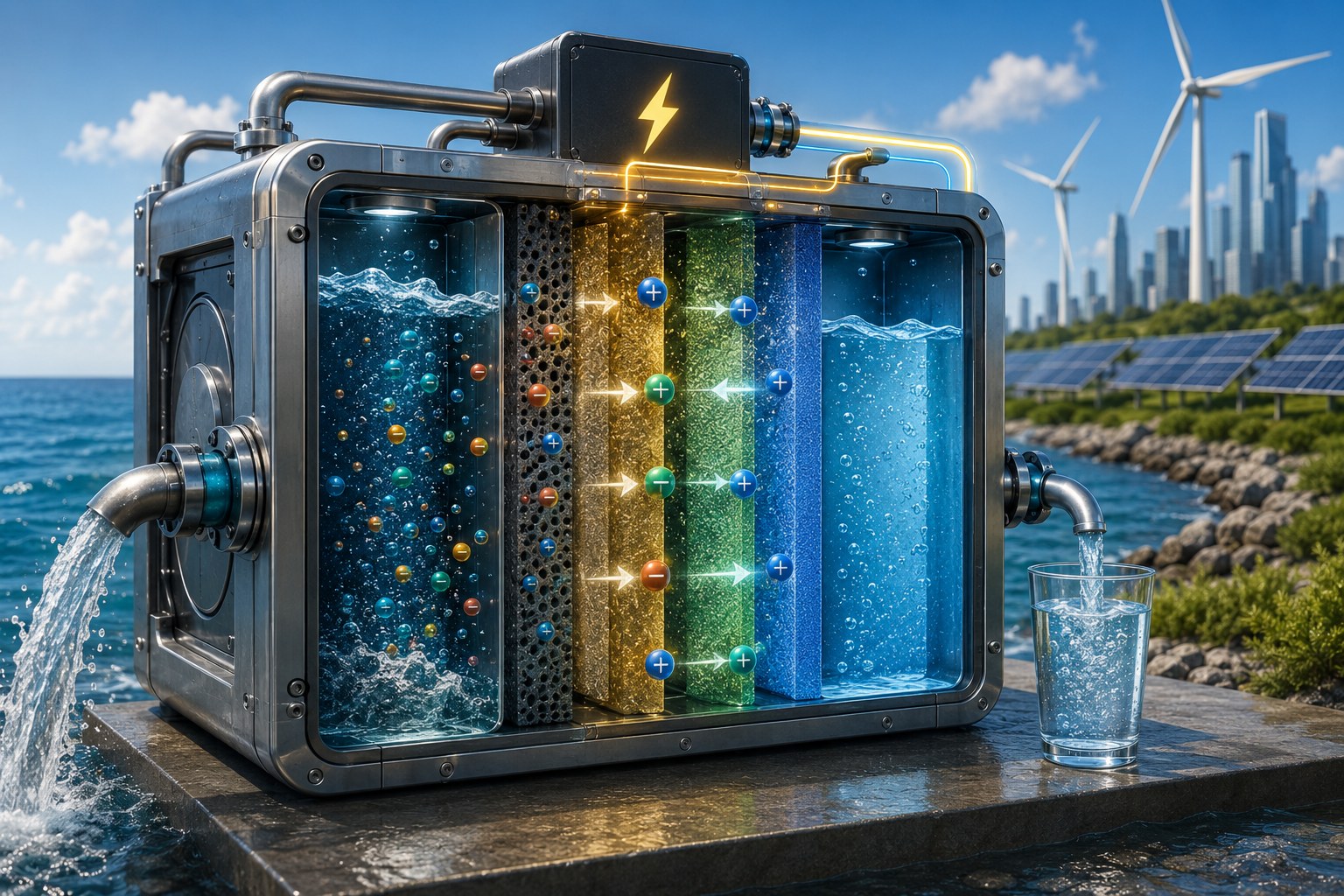
The concept behind Liquid Nanoclay is elegant in its simplicity. The problem with the traditional approach of mechanically mixing clay into sandy soil has always been scale, cost, and effectiveness: heavy machinery is required, the volumes needed are enormous, and the clay particles are orders of magnitude larger than the sand particles they are meant to bond with. Desert Control's innovation is to break clay down to nanoparticle scale, particles just 1.5 nanometres thick - and suspend them in water to create a sprayable liquid that can be applied through conventional irrigation equipment.
| Step | Mechanism | Outcome |
|---|---|---|
| 01 · Clay nanonisation | Patented mixing process breaks clay into 1.5 nm particles | Particles small enough to coat individual sand grains uniformly |
| 02 · LNC application | Liquid is sprayed through standard sprinklers, drip lines, or flood irrigation | No specialist equipment; no heavy machinery; no soil disturbance |
| 03 · Deep penetration | Liquid saturates soil to ~60 cm depth, the root zone for most crops | Clay particles form a continuous binding film around every sand grain |
| 04 · Sponge effect | Coated sand retains moisture and nutrients instead of shedding them to the water table | Sandy soil now behaves like clay-rich earth, supporting continuous plant growth between irrigation cycles |
The analogy the company uses is apt: the treated soil becomes a giant sponge inserted just below ground level. Where previously water and fertiliser would pass straight through loose sand to the groundwater table, uselessly, expensively, and without contributing to plant growth, the LNC-treated soil now absorbs and retains them within the root zone. Plants growing in treated soil have continuous access to the moisture and nutrients they need between irrigation cycles, which is the mechanism behind both the yield improvements and the water savings.
Critically, the process uses no chemicals of any kind, only clay and water. There are no synthetic compounds, no persistent residues, and no disruption to soil biology beyond the physical transformation of water retention. Treated soil actually develops better conditions for plant-boosting mycorrhizal fungi over time. The 1.5-nanometre clay coating degrades naturally as the soil is worked and weathered, requiring periodic reapplication, a recurring revenue model for the company and a maintenance cost for the farmer that is typically offset many times over by the water and yield improvements.
No chemicals. No machinery. Just clay and water, applied at nanoscale through the irrigation infrastructure the farm already has. That combination is what turns a centuries-old soil-improvement practice into a scalable industrial technology.
What the field trials show, documented results from the UAE to California
The performance data from Desert Control's field trials, conducted across multiple geographies, soil types, crops, and climate conditions, is consistent enough to be compelling and specific enough to be analytically useful. The results span both yield improvement and water conservation, with different emphases emerging across different deployment contexts.
| Location · Crop | Result | Commercial significance |
|---|---|---|
| Abu Dhabi · cauliflower & carrots | +108% larger crops vs. untreated control plots | Validates LNC in extreme arid conditions with high-value vegetable crops |
| Egypt · wheat (Agricultural Research Centre) | 4× yield (+416% above untreated fields) | Most dramatic documented result; Egyptian state research validation |
| Dubai desert · watermelon, pearl millet, zucchini | Commercial crops grown in open-desert conditions | Proof of concept for extreme-environment deployments |
| MENA aggregate · multiple crops | −77% irrigation water requirement | Decisive in water-constrained markets where water cost is the binding input |
| Arizona · Limoneira citrus | 2,000 trees commercially treated; scaled from 50-tree pilot | Pilot-to-commercial conversion in a US public-company customer |
| California · Oasis Dates (Medjool) | 9,000 trees · 160 acres · potential expansion to 5,000 acres | Largest-ever commercial deployment (Q1 2025); high-value permanent crop |
| Aggregated trials · soil fertility | +40% increase in soil fertility metrics | Long-term soil-health improvement, not just one-cycle yield uplift |
| Desert deployments · surface temperature | Up to −15°C surface temperature | Climate co-benefit; reduces heat-island effect in degraded zones |
Two findings carry disproportionate commercial weight. First, the 77% irrigation reduction in MENA trials translates directly into operating-cost savings in any market where water is priced, regulated, or scarce, and the list of those markets is structurally expanding. The US Southwest, the Mediterranean basin, the Arabian Peninsula, North Africa, much of Australia, and parts of Latin America all face combinations of falling water tables, tightening water rights, and rising water prices. Any technology that compounds water productivity by 4× has automatic relevance in those geographies independent of yield gains.
Second, the California market has an additional accelerant that other geographies do not yet have: water-utility rebates. Southern California water utilities are now offering direct financial incentives for LNC adoption, reducing the upfront cost barrier that has historically slowed uptake. This regulatory support effectively subsidises Desert Control's customer acquisition and dramatically improves the payback period for farmers and golf-course operators evaluating the technology, turning what would be a 3–5 year payback into something closer to immediate cash-flow positive in the highest-value deployment cases.
Desert Control in 2026, from research promise to commercial reality
The gap between a promising technology and a functioning commercial business is where most agritech innovations fail. Desert Control has navigated that gap, with difficulty, with patience, and now with accelerating momentum. The company today is genuinely commercial, genuinely revenue-generating, and genuinely expanding, while still carrying the financial characteristics of an early-stage listed company that has not yet reached profitability.
| Metric | Current state | Commercial significance |
|---|---|---|
| Listing | Oslo Stock Exchange · ticker DSRT | Publicly traded; institutional and retail investor access; subject to OSE disclosure regime |
| 2026 revenue outlook | USD 2–3 million expected | Up from prior years; based on current pipeline plus 26 pilots active in H1 2026 |
| Pilot pipeline | 26 pilots in H1 2026 vs. 7 in full-year 2025 | Almonds, dates, grapes, pistachios, avocados, diversification across crops |
| Production capacity | 120,000 L/hr · Next-Gen system live mid-2025 | 8× capacity increase from prior generation; relieves supply-side scale-up risk |
| Cash position | Runway extends to September 2026 after H1 2025 USD 13M equity raise | Financing review targeting an additional USD 15M underway |
| Recognition | Identified by WWF as a global Climate Solver | Third-party validation that strengthens the carbon-market narrative |
The honest assessment, what could still go wrong
Desert Control's technology works. The field trial evidence is consistent, the commercial deployments are generating genuine revenues, and the science has been independently corroborated through EU Cordis-funded projects. The investment risk profile is not about whether the technology is real, it is about whether the company can scale fast enough, sustainably enough, and with sufficient capital efficiency to reach profitability before its financial runway constrains its options.
At $2–$5/m², LNC treatment remains too expensive for low-income farmers, the populations with the greatest absolute need are not yet the addressable market. Mass-adoption economics in developing-world agriculture require a step-change cost reduction. Next-Gen production capacity (8× volume) is intended to drive that reduction, but the published per-unit economics have not yet caught up. Until they do, the commercial market is high-value permanent crops, regulated water markets, and licensed deployments, not subsistence farming.
Cash runway extends to September 2026; a financing review targeting USD 15M is underway. Scaling from 7 pilots in 2025 to 26 in H1 2026, and presumably more thereafter, demands operational bandwidth at a company with limited management headcount. The PAYS model defers revenue recognition until measurable water savings are confirmed, creating a structural lag between deployment and cash receipt. Capital Markets Day disclosures will determine whether the runway and execution match the pipeline ambition.
| Risk | Evidence | Mitigation |
|---|---|---|
| Cash runway | Cash dropped from NOK 105M (Q1 2024) to NOK 43M (Q1 2025) before equity raise | USD 13M raise completed mid-2025; further USD 15M financing review in progress; PAYS defers capital requirements |
| Revenue timing under PAYS | Pay-As-You-Save defers cash receipt until savings are documented | Contract mix balances PAYS and upfront-payment deals; MENA licensing provides faster conversion |
| Cost per square metre | $2–$5/m² is uneconomic for subsistence agriculture in developing markets | Next-Gen production (8× capacity) targets unit-cost reduction; licensing model passes scale economics to partners |
| Long-term durability of treatment | Clay coating degrades over time; requires periodic reapplication; long-term ecosystem effects not fully characterised | Reapplication is a revenue model, not a defect; multi-year UAE and Egypt data accumulating with no adverse effects documented |
| Technology replication risk | Nanoclay chemistry is not inherently complex; better-capitalised competitors could develop similar systems | Patent protection plus operational know-how; first-mover advantage in PAYS contract relationships creates customer lock-in |
| Scale-up execution | Moving from 7 pilots to 26+ requires operational scale-up at a small company | Experienced US sales team added; Next-Gen production system supports volume; Capital Markets Day to detail execution capacity |
A different kind of green revolution
There is something almost counterintuitive about a Norwegian startup solving a problem most acutely felt in the deserts of the Arabian Peninsula, the Nile Delta, and the American Southwest. But Norway's relationship with nanotechnology research, combined with the founding team's decision to take a centuries-old agricultural insight, mix clay into sandy soil, and apply it at a scale that centuries of farming practice could never achieve, has produced something genuinely significant. Liquid Nanoclay is not a miracle cure for the global food and water crisis. It is a tool, a powerful, scalable, chemically benign tool, that addresses a specific and important part of the problem.
The technology is real. The field trials are consistent. The commercial traction in California and the Middle East is growing. The company is listed, public, and subject to the scrutiny of financial markets that have now followed it through years of development. What remains is the execution challenge of turning a proven technology with an obvious market into a financially sustainable business at the scale the problem demands. The PAYS model may prove to be the breakthrough that unlocks that scale, removing the upfront cost barrier, aligning revenue with documented customer outcomes, and creating the kind of recurring, outcome-linked commercial relationships that support long-term business stability. If the 26 pilots planned for H1 2026 convert at the rates the pipeline suggests, 2027 could be the year that Desert Control moves from early-stage promise to mid-stage commercial momentum.
Every year, land the size of a small country is lost to desertification. Every seven hours, Desert Control's technology can take a hectare of barren sand and make it farmable again. The arithmetic of the problem is clear. The arithmetic of the opportunity is becoming equally clear.
Turning sand into soil changes what a parcel of land is worth. The firm reads ground conditions through its geospatial intelligence workstation, and the economics around them through its private intelligence practice.
Sources: Singularity Hub editorial coverage (August 2020); Desert Control AS company announcements and press releases (2024–2026); Oslo Stock Exchange filings; EU Cordis project documentation (project ID 876908); Ainvest financial analysis (August 2025); Desert Control investor relations materials; WWF Climate Solver listing. This note is for informational purposes only and does not constitute investment advice. References to Desert Control (OSE: DSRT) are informational and not a recommendation to buy, sell, or hold any security. Field trial results and forward-looking statements are subject to significant uncertainty.