The breakthrough in four numbers
The hydrogen economy has a hidden water problem. This reactor may have just solved it.
Green hydrogen, produced by splitting water with renewable electricity, is widely considered essential to the global energy transition. It can decarbonise industrial heat, provide long-duration storage, and fuel sectors that batteries cannot reach: shipping, aviation, steel, ammonia. The roadblock is not scientific. It is a cost problem with a geographic dimension that has received insufficient attention. Green hydrogen's cheapest electricity and its required water feedstock are concentrated in opposite places on the map.
Conventional electrolysers require ultra-pure water. The world's best renewable energy sites, coastal Morocco, the Chilean Atacama, Australia's northwest, the Arabian Peninsula, are precisely where ultra-pure water is scarcest and most expensive. The standard fix is to bolt a reverse-osmosis desalination plant onto every coastal green hydrogen project, adding capital cost, operating cost, and energy overhead. The NTU Singapore team's reactor eliminates that bolt-on entirely: it produces hydrogen and drinking water from raw seawater in a single integrated cell, with the coupling factor data to back the "no compromise" claim. If the architecture scales, the cost floor of coastal green hydrogen drops measurably, and the geography of the energy transition simplifies.
The world's best places to make green hydrogen are on coastlines. The world's best electrolysers refuse to run on seawater. That contradiction, until now, has been one of the most quietly important cost barriers in the entire energy transition.
How the reactor works, three chambers, two membranes, one porous solid electrolyte
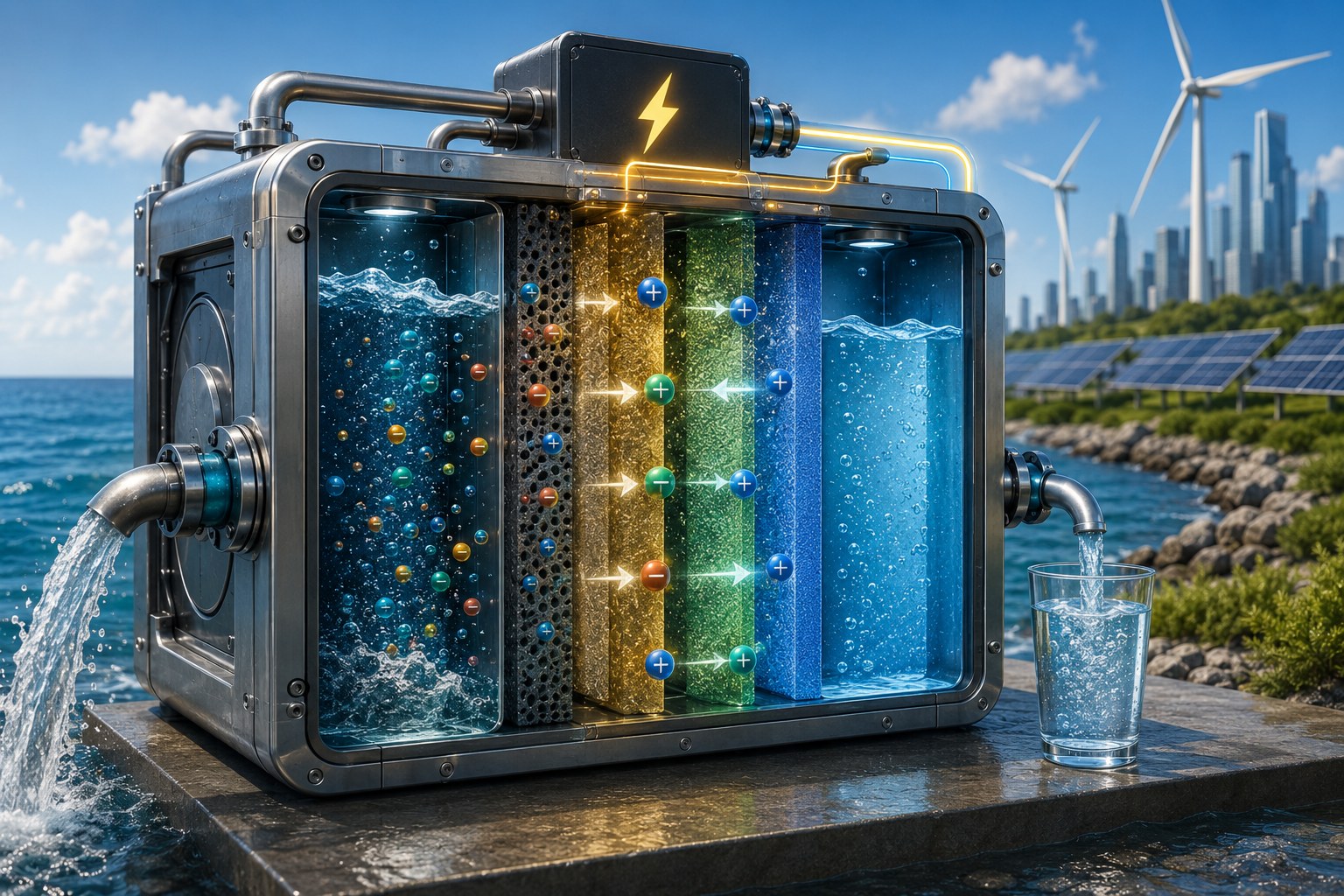
The NTU Singapore team's solution is not an incremental improvement on the sequential desalinate-then-electrolyse approach. It redesigns the system architecture, combining what were previously three separate processes into a single integrated electrochemical cell.
| Chamber | Reaction | Conditions | Output |
|---|---|---|---|
| Cathode | 2H⁺ + 2e⁻ → H₂ (hydrogen evolution) | Acidic; protons reduced; chlorine formation prevented by pH separation | Green H₂ gas |
| Central (seawater) | Na⁺ and Cl⁻ extracted through bipolar membranes (electrodialysis) | Porous solid electrolyte transports ions while the bipolar membranes drive salt outward | Desalinated water |
| Anode | 2H₂O → O₂ + 4H⁺ + 4e⁻ (oxygen evolution) | Alkaline; optimised catalyst resists chloride attack | O₂ gas (vented) |
The critical innovation is the porous solid electrolyte (PSE). Conventional electrolysers use a liquid electrolyte filling the space between electrodes, and liquid electrolytes are operationally fragile in the presence of seawater ions. The PSE provides a stable, solid medium through which ions can migrate reliably, maintaining the precise electrochemical conditions of each of the three chambers simultaneously. That is what allows the ~100% coupling factor: the energetic cost of desalination is absorbed within the existing electrolysis process rather than requiring additional energy input.
The bipolar membrane architecture is equally important. Bipolar membranes allow ions to migrate in a controlled directional manner, maintaining acidic conditions in the hydrogen-evolution chamber and alkaline conditions in the oxygen-evolution chamber simultaneously. That pH separation is what prevents chlorine formation at the anode, the chemical reaction that makes direct seawater electrolysis toxic and damaging in conventional systems. The salt ions from the central seawater chamber are drawn outward through the membranes during each electrical cycle, desalinating the water as a natural consequence of the electrolysis process rather than as a separate step.
The porous solid electrolyte does not add a new process to electrolysis. It allows the existing electrochemical potential driving hydrogen production to simultaneously perform desalination, essentially getting freshwater as a thermodynamic consequence of making hydrogen.
What the data shows, and what it does not yet prove
The Nature Sustainability paper provides specific, verifiable performance data at laboratory scale. Understanding both what the results demonstrate and what remains for commercial deployment is essential for any serious assessment of the technology's near-term implications.
| Dimension | Current status | Commercial requirement |
|---|---|---|
| Simultaneous H₂ + desalination | Confirmed at lab scale; coupling factor ~100% | Same process at multi-MW scale |
| Freshwater output quality | ~2.1 t per kg H₂, meeting potable standards | Consistent quality at scale; regulatory certification |
| Chloride corrosion resistance | Optimised catalyst resists anodic Cl⁻ attack | Catalyst stability over 80,000+ hours |
| Real (unmodified) seawater | Confirmed, not idealised lab water | Seasonal and geographic seawater variation |
| Long-term durability | 360 hours demonstrated | 80,000–100,000 hours for commercial lifetime |
| Scale-up to MW output | Laboratory prototype only | Multi-MW stack engineering |
| Manufacturing cost | Not published | $/kW comparable with PEM / alkaline incumbents |
| Membrane replacement economics | Not specifically addressed | Bipolar membranes are consumable, replacement cycle is a key cost driver |
Two findings carry disproportionate weight. First, the ~100% coupling factor demonstrates the architectural claim: integrating desalination into electrolysis does not impose a meaningful energy penalty. If the coupling factor had landed at 70%, or 85%, the technology would still be interesting, but the value proposition would be partially eroded by the additional electricity required. At ~100%, the freshwater is effectively a free thermodynamic byproduct of hydrogen production. Second, the 360-hour run on real seawater addresses the single failure mode that has historically killed direct seawater electrolysis projects: chloride corrosion at the anode. The optimised catalyst and pH-separation architecture solve the problem in principle. Multi-year durability data remains the next milestone, but the corrosion question is no longer open.
Where it fits, the coastal renewable energy zones
The PSE reactor is not a universal electrolyser improvement. It is a specifically targeted solution for a specifically constrained context: coastal regions with abundant renewable energy and scarce freshwater. That specificity is a strength, it maps precisely onto the locations with the greatest potential for large-scale green hydrogen production and the greatest current constraint on realising that potential.
Investment implications, what changes if this scales
The PSE reactor is at an early technology readiness level, a confirmed laboratory proof of concept, not a deployable product. The investment implications operate on two horizons: the near-term signal the research sends about the direction of electrolyser development, and the medium-term commercial opportunity if the architecture scales as its underlying physics suggest it should.
Green hydrogen projects are usually underwritten on a single off-take agreement for hydrogen supply. A project that simultaneously produces potable water creates a second independent revenue stream, different price, different counterparty, different demand profile. That diversification improves bankability, reduces single-commodity exposure, and may allow coastal green hydrogen projects to achieve lower financing costs and higher leverage ratios. In water-scarce regions where governments are active purchasers of desalinated water, a sovereign water off-take could effectively subsidise the hydrogen.
360 hours and a laboratory prototype leave significant ground to cover. Electrolyser stacks operate for years, not weeks. The membrane and catalyst must demonstrate stable performance at conditions that accelerate degradation in ways short-duration tests may not surface. The architectural complexity of a three-chamber cell, relative to conventional two-chamber electrolysers, may introduce manufacturing cost and assembly challenges. Treat this as a 3–8 year commercialisation horizon, not an immediately actionable technology.
| Category | Near-term signal | Medium-term opportunity |
|---|---|---|
| Coastal H₂ project developers | PSE reduces the water-cost assumption in coastal project models | MENA, Australia, Chile projects that currently require separate desal become more competitive |
| Electrolyser incumbents | Signal: seawater-capable architectures are a viable development direction | NEL, ITM, Cummins, Plug Power, R&D capacity to license or independently develop similar designs |
| Bipolar membrane makers | Membrane quality and longevity become critical variables | Demand expansion if PSE architecture is adopted; small, specialised supply base currently |
| Coastal desal economics | Water as co-product could displace some planned standalone desal capacity | H₂ export hubs in water-scarce regions produce freshwater for domestic supply as revenue diversification |
| Integrated coastal infra | New project-finance category: H₂ + water revenue from one coastal renewable asset | Off-take agreements for both outputs improve bankability and reduce single-commodity risk |
| NTU IP position | Published research likely accompanied by patent filings on the PSE architecture and catalyst design | Technology licensing to commercial electrolyser manufacturers; potential spin-out company |
| Catalyst materials | Optimised Cl⁻-resistant catalyst is a key proprietary element | Speciality chemicals and PGM catalyst suppliers positioned for seawater-electrolyser demand |
The ocean has always held the answer. The reactor now extracts it.
The green energy transition has a geography problem. The best renewable resources, the sunniest coastlines, the windiest offshore sites, are concentrated in regions where the conventional assumption that clean water will be available and affordable turns out to be wrong. The standard response has been to bolt on separate, expensive desalination infrastructure and feed its output to the electrolyser. It works. It is also wasteful, costly, and ultimately contradictory: using energy to make water to make hydrogen from water.
The NTU Singapore team's porous-solid-electrolyte reactor takes a fundamentally different approach. Rather than treating water purification and hydrogen production as sequential steps, it recognises them as electrochemically compatible processes that can share the same driving potential, the same cell, and the same infrastructure, yielding both outputs simultaneously from raw seawater, with neither compromising the other.
The published result is a laboratory proof of concept, not a commercial product. The gap between demonstrating a principle for 360 hours at bench scale and deploying it at gigawatt scale for decades requires engineering work the paper does not claim to have completed. That gap is real, and any serious investor should calibrate accordingly. But the underlying physics are now confirmed. The coupling factor approaches the theoretical maximum. The chloride corrosion problem, open since the first attempts at seawater electrolysis, is now closed. And the 2.1 tonnes of potable water per kilogram of hydrogen is not a footnote: it is a commercially significant co-product that transforms the project economics of coastal green hydrogen from a single-output energy business into a dual-output resource business.
Seawater contains everything the hydrogen economy needs, H₂O molecules to split, and an ocean's worth of it. The only thing missing was a reactor that could use it directly. One has now been published in a peer-reviewed journal. The commercialisation clock has started.
Sources: Xu, Z.J. et al., "Electrolysis with built-in seawater desalination by porous-solid-electrolyte reactor," Nature Sustainability 9, 523–532 (2026); doi: 10.1038/s41893-026-01772-4; published online 17 February 2026. Additional context from publicly available NEOM, IRESEN, REPowerEU, and IEA green hydrogen documentation. Cover illustration is a schematic rendering; the published paper contains the authoritative reactor diagrams and electron-micrograph data.