
The numbers that frame it
OHISAMA is a well-scoped experiment attached to a fragile schedule. What it measures, whether a microwave beam can be held on a fixed ground target from a moving platform and converted back into usable electricity, is a bounded engineering question that a demonstrator of roughly a kilowatt can answer. What decides when the answer arrives is a launch vehicle that has yet to reach orbit, and what decides whether the answer matters commercially is a cost and scale gap that no kilowatt-class experiment touches.
The headline that already slipped
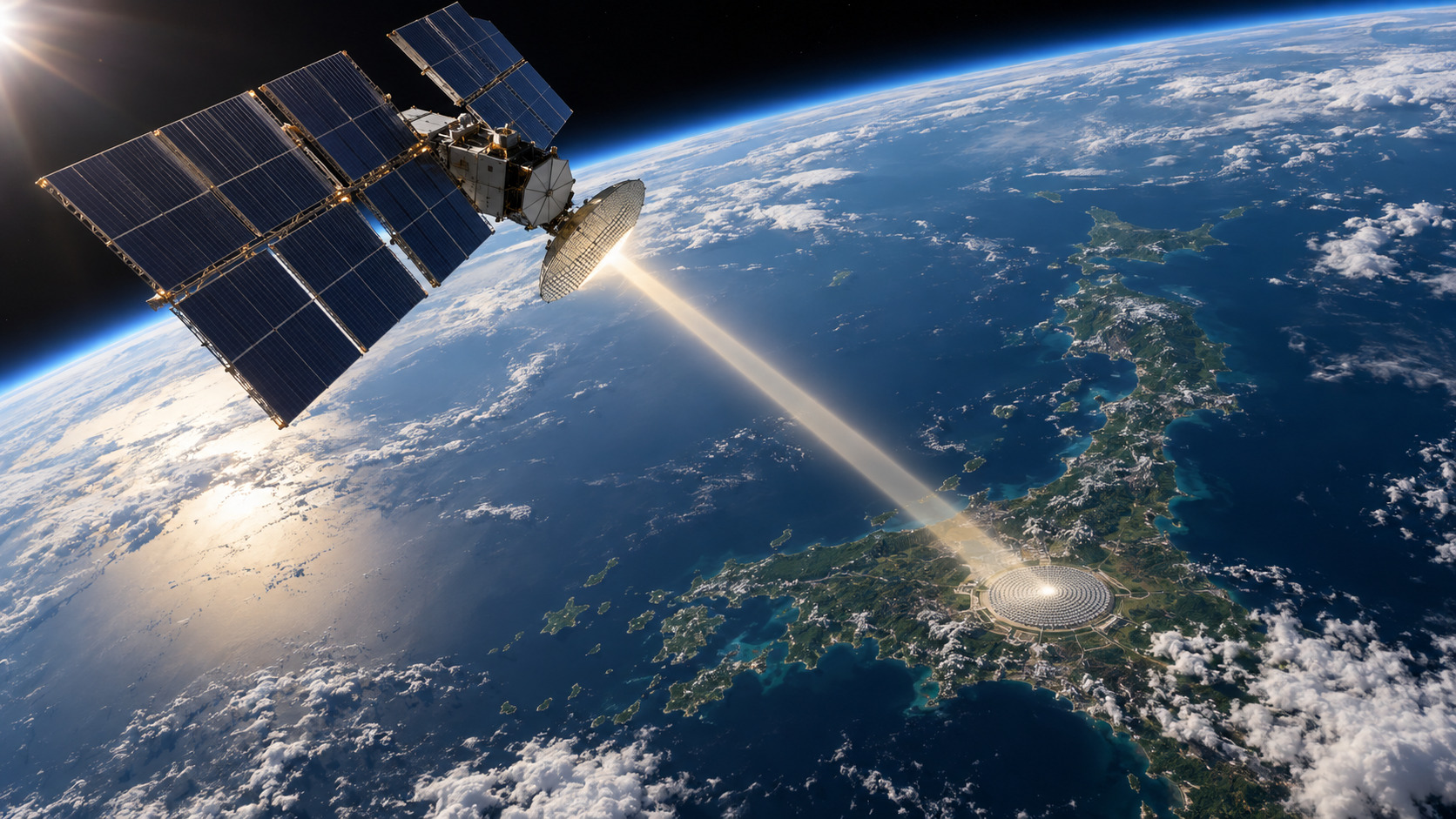
Coverage through 2025 described Japan's OHISAMA satellite as a 2025 event: a demonstrator that would collect sunlight in low Earth orbit, convert it into microwave energy, and beam it to a receiving station in Nagano Prefecture. If it succeeds, the programme's own framing is that it would be the first orbital demonstration of beaming solar-derived power to a ground target. That date has passed. As of mid-September 2026, the most recent coverage we reviewed describes the satellite as slated for Japan's fiscal 2026, which runs from April 2026 to March 2027, and as manifested on the fifth flight of Space One's Kairos rocket.
The distinction between a slipped schedule and a failed experiment matters here, and the public record does not yet say which this is. The satellite is described in current reporting as a planned demonstrator of roughly 180 kilograms, and no launch has occurred. Nothing about the underlying physics has been tested in orbit, and nothing about it has been disproved either. What has changed since the 2025 headline is the part of the programme that the original coverage barely mentioned: the vehicle.
The firm's framework for assessing demonstration programmes of this kind separates the physical claim being tested from the chain of dependencies that must hold before it can be tested at all. Space-based solar power has three such links in sequence: an orbit has to be reached, a beam has to be pointed and converted, and the resulting power has to be competitive with what a ground-based alternative delivers. OHISAMA is designed to speak to the middle link. The first link currently carries the schedule risk, and the last is outside its scope.
01 · What the demonstration tests
Stripped of the long-term ambition, OHISAMA is a compact experiment with a short list of measurable outputs, and its design choices show which questions its sponsors consider closest to answerable.
Public descriptions from Japan Space Systems, the nonprofit research foundation leading the programme with support from Japan's Ministry of Economy, Trade and Industry, put the satellite at about 180 kilograms in a low orbit somewhere between 400 and 450 kilometres. A single integrated panel on the order of two square metres collects sunlight and re-emits it as microwave energy at 5.8 GHz toward a ground station, with maximum output reported at about 720 watts and rounded to roughly a kilowatt in some accounts. That is the electrical scale of a household appliance, and deliberately so: the experiment is built to measure how well the chain works, and the energy it delivers is incidental.
Two details in that list deserve attention. The first is the beam-control requirement. The reported limit of less than 0.001 degrees applies while the satellite crosses the sky at roughly 7.6 kilometres per second. From 400 kilometres up, an error of 0.001 degrees displaces the beam by about seven metres at the ground, and by about eight metres from 450 kilometres; those figures are the firm's arithmetic on the reported values, not a stated mission budget. Against a receiving area reported at roughly 600 square metres, which would be about 24 metres on a side if it were a single square, that leaves a pointing margin that is demanding but not unreasonable, and it explains why beam steering rather than solar conversion is the headline technical risk.
The second detail is that public accounts describe the receiving segment differently, citing a thirteen-antenna array near Suwa in some reports and a large parabolic dish at a JAXA tracking station in others. We treat the exact ground configuration as not yet settled in the public record, and we would expect the final arrangement to be fixed closer to a confirmed launch date.
02 · The rocket is the first link
The programme's critical path starts before the satellite does anything. OHISAMA is slated to ride Kairos, a small commercial launch vehicle operated by Space One from Spaceport Kii in Wakayama Prefecture, and that vehicle has not yet delivered a payload to orbit.
The record is short and unambiguous. The first flight, on March 13, 2024, ended when the flight termination system destroyed the vehicle about five seconds after liftoff, which was attributed to lower-than-intended thrust. The second, on December 18, 2024, lost attitude control around first-stage separation and was observed tumbling at roughly 95 seconds. The third, on March 5, 2026, was terminated after performance anomalies during first-stage flight, and the five small satellites aboard were lost. As of mid-September 2026, the coverage we reviewed described no subsequent flight and gave no date for the conclusions of the failure investigation or for a return to flight.
A demonstration satellite is only as punctual as its rocket. OHISAMA's physics can be right and its calendar still wrong, because the first link in the chain is a launch vehicle with three failures in three attempts.
What this does to the OHISAMA timeline is mostly arithmetic about cadence. A vehicle that has not flown since March 2026 needs a root-cause finding, a corrective change, and at least one further flight before a customer payload of this significance can responsibly be manifested, and the reporting places OHISAMA on the fifth Kairos flight, which implies at least one flight ahead of it. Each of those steps carries its own schedule uncertainty. We read the move from 2025 to fiscal 2026 as a first slip and the fiscal 2026 date as conditional rather than committed, which is a judgement about exposure and makes no forecast of when the satellite will fly.
A programme in this position has a recognisable alternative, which is to move the payload to a different launch provider. That would trade the vehicle risk for a new integration cycle and for a policy question about flying a nationally sponsored demonstrator on another operator's rocket. Nothing in the public record suggests that choice is being weighed, and we flag it only because it is the lever that would most change the schedule exposure described above.
03 · A low-orbit proof, a geostationary business
Even a clean flight would leave the commercial question mostly untouched, because the long-term case depends on a different architecture from the one OHISAMA tests in low orbit.
A satellite at 400 kilometres circles the Earth in roughly 90 minutes and stays above the horizon of any single ground station for a matter of minutes per pass. Taking a generous five-minute transmission at the reported 720-watt peak as an illustration, the energy delivered to the ground is on the order of 0.06 kilowatt-hours, about two-tenths of one percent of the roughly thirty kilowatt-hours an average American household uses in a day. That is why the experiment sits in low orbit, where launch is cheaper and a failure is survivable. The demonstration's output is information, and the energy it delivers is negligible.
The commercial architecture described in public accounts is different in kind: arrays on the order of 2.5 kilometres square in geostationary orbit, some 36,000 kilometres up, feeding a ground antenna on the order of four kilometres across, with about a gigawatt per unit as the target and dates for that capability ranging from the 2040s to the 2050s depending on the account. From geostationary orbit the satellite hangs fixed over the receiver and can in principle transmit around the clock, which is what turns a beam into a power plant. It also changes every quantity OHISAMA measures. Pointing, propagation, conversion efficiency, structural scale, and launch mass all become different problems, and the step from a 720-watt demonstrator to a gigawatt-class array is a factor of roughly 1.4 million on the firm's arithmetic.
The honest scale of what OHISAMA retires is easiest to see as a ledger. It addresses the middle of the chain, partially, and leaves both ends open.
| Link in the chain | What OHISAMA addresses | What stays open |
|---|---|---|
| Reaching orbit | Nothing directly; the satellite depends on the vehicle | Kairos has not yet delivered a payload to orbit; the schedule is exposed to its return to flight |
| Beam pointing | Whether a 5.8 GHz beam can be held on a fixed ground target within the reported sub-0.001 degree limit | Pointing at geostationary range and at array scale is a different engineering problem |
| End-to-end conversion | Sunlight to microwave to usable electricity at the ground, at roughly a kilowatt or less | Conversion efficiency across a far larger system |
| Propagation | Atmospheric and ionospheric effects on a low-power beam, a stated measurement objective | Behaviour at gigawatt-class power levels |
| Scale | A demonstrator of 720 watts to about 1 kW | A step of roughly one million-fold or more to a 1 GW array |
| Cost | Not addressed | A NASA-cited gap of up to roughly ten times versus land-based solar or wind |
04 · What a successful demonstration will not change
A successful flight would improve the evidence base without changing the economics, and the public record gives three reasons to keep those two things separate.
The first is cost. Public reporting cites a NASA assessment putting space-based generation at up to roughly ten times the cost of land-based solar or wind, and nothing in a kilowatt-class demonstrator measures launch cost per kilogram, array mass per kilowatt, or the cost of the ground segment. A beam that points perfectly does not move that ratio.
The second is that OHISAMA would not be the first experiment to touch the chain. The US Naval Research Laboratory's PRAM experiment in 2020 and Caltech's MAPLE demonstrator in 2023 each showed elements of in-orbit conversion and transmission, and the Caltech unit reportedly detected a signal without delivering usable electricity. China is reported to be planning kilometre-scale arrays in the 2030s. Japan has researched the concept since the 1980s and has carried space solar power as a national policy goal since 2009. A programme that has waited more than four decades for an orbital test is not one whose timeline moves quickly on the strength of any single success.
Proving that a beam can be steered does not prove that it can be sold. The distance between those two claims is measured in launch cost per kilogram and in orders of magnitude of scale, and a kilowatt-class demonstrator closes neither.
The third is what success would actually unlock. It would validate beam control and end-to-end conversion at low power, which de-risks the engineering narrative for the next demonstrator and strengthens the funding case for it. It would not authorise a gigawatt programme, because the decision to build one rests on the cost ratio above and on launch economics that sit outside the project entirely.
Conclusion
The 2025 headline described a demonstration that has not yet happened, on a schedule that has already moved, depending on a rocket that has not yet reached orbit. OHISAMA reads as a well-scoped experiment attached to the most exposed link in the chain. Whether the beam can be steered is a bounded engineering problem that the demonstrator is designed to answer. The firm's view is that the more informative questions to follow are whether Kairos returns to flight on a credible schedule, whether the programme keeps its place on the manifest, and whether any later phase begins to put numbers on launch cost and array mass. Those indicators will say more about the trajectory of space-based solar power than the first beam does.
The beam is the experiment, the rocket is the schedule, and the cost curve is the business. OHISAMA tests the beam, depends on the rocket, and is silent on the cost.
Sources: Reporting on OHISAMA and Japan Space Systems via Space.com, ITBusinessToday, Futura-Sciences, and the Japan Earth Observer news roundup of September 16, 2026; Kairos launch history via The Japan Times, Space.com, and public launch records. Figures described as the firm's arithmetic are illustrative derivations from publicly reported values and are not forecasts. This note is for informational purposes only and does not constitute investment advice.