
The story in four numbers
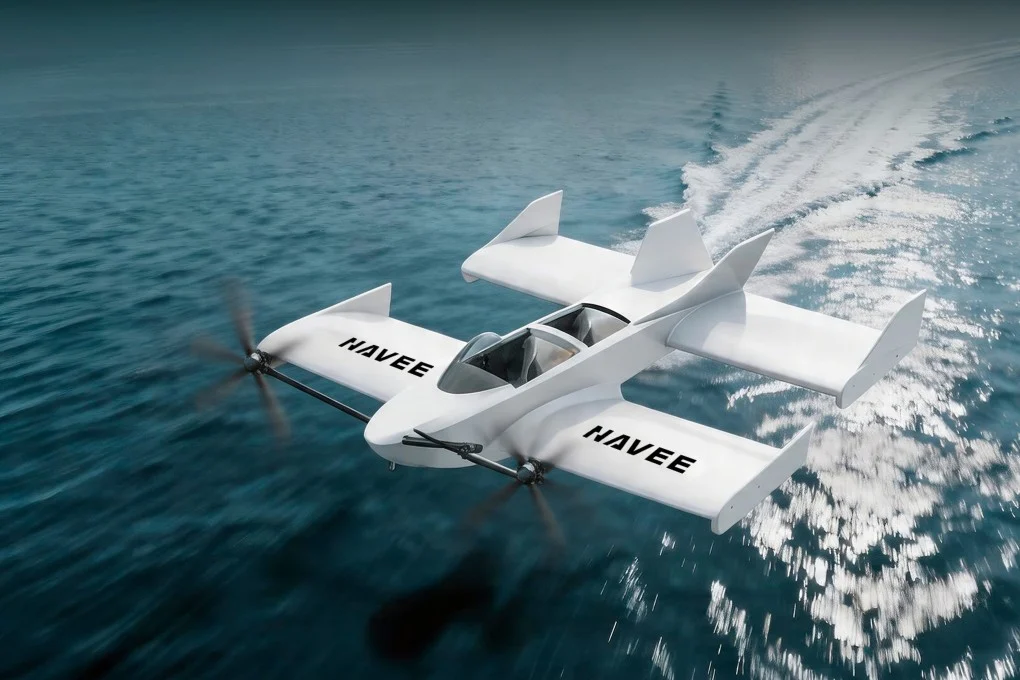
The wing-in-ground effect — the aerodynamic phenomenon that allows a wing operating close to a surface to generate more lift and less drag than the same wing in free air — has been known since the early twentieth century and deployed at industrial scale in Soviet military ekranoplans that crossed the Caspian Sea at 500 km/h carrying tanks and troops. It has never, until NAVEE, been made into a consumer product. The firm reads NAVEE's launch as a signal about two distinct things: the maturation of lightweight composite and electric powertrain technology to the point where ground-effect vehicles can be built at consumer scale and cost, and the deliberate cultivation by China's government of a low-altitude mobility ecosystem that is creating commercial space for vehicle categories that have no precedent in the existing regulatory and market landscape.
What the ground effect actually is
The wing-in-ground effect — referred to in engineering literature as WIG, and historically called the ekranoplan effect from the Russian word for screen-plane — is not a mystical or exotic phenomenon. It is a predictable consequence of how a wing generates lift. Under normal flight conditions, the high-pressure air beneath a wing escapes around the wingtip, creating a vortex that contributes to induced drag — the energy cost of producing lift. When the same wing operates within approximately one wingspan of a surface, that escape path is partially blocked by the surface itself, the pressure beneath the wing builds more efficiently, and both lift increases and induced drag decreases. The effect is most pronounced at altitudes below half a wingspan and essentially absent above one wingspan. For a vehicle with a wingspan of, say, three metres, the operational window of significant ground effect benefit is therefore the first one-and-a-half metres above the surface — a zone that is below the threshold of conventional aviation regulation, above the surface contact of a boat, and at the speed and altitude intersection that makes the WIG vehicle a genuinely novel category of mobility rather than an incremental improvement on either. The practical consequence is a vehicle that can move faster than a conventional displacement-hull boat, with dramatically less energy per kilometre than a conventional aircraft, and with operational characteristics — open water, near-surface, weather-sensitive — that are distinct from both. NAVEE's consumer craft operates within this envelope, and the 53 mph speed claim is a function of the ground effect efficiency gain as much as it is of raw propulsive power.
01 · The physics were proven at scale — and then abandoned
The Soviet Union demonstrated that the wing-in-ground effect could be operationally viable at extraordinary scale. The reasons that demonstration did not produce a commercial market are as instructive as the physics itself.
The most famous application of the WIG principle was the Soviet Ekranoplan programme of the 1960s through 1980s, which produced vehicles of extraordinary scale: the KM — nicknamed the Caspian Sea Monster by NATO intelligence analysts — was 92 metres long, weighed 540 tonnes at maximum take-off weight, and cruised at approximately 500 km/h at an altitude of 4 metres above the Caspian Sea. It was not a prototype; it was a functional military logistics vehicle that flew operationally for over a decade before sinking in an accident in 1980. The Lun-class ekranoplan that followed was designed as a missile carrier. The scale of these vehicles was deliberate: the ground effect efficiency advantage compounds with size, because a larger wingspan means the ground effect zone extends higher, allowing the vehicle to operate at altitudes that are more tolerant of wave height variation. The Soviet military ekranoplans were designed for the specific operational environment of large, relatively calm inland seas — the Caspian, the Black Sea, the Baltic — where wave height rarely exceeded the vehicles operating altitude. Their abandonment after the Soviet collapse was partly financial and partly operational: the vehicles were expensive to maintain, required calm-water conditions that limited their strategic utility compared with submarines and conventional aircraft, and had no commercial analogue at the time. The lesson the firm draws from this history is not that WIG technology is inherently limited — it is that the Soviet programme was solving a specific military logistics problem at maximum scale, and that the failure to produce a commercial market from those efforts was a function of cost structure, regulatory vacuum, and the absence of the lightweight material and electric powertrain technology that makes consumer-scale WIG economically rational. NAVEE is arriving after those technologies have matured.
The Soviet ekranoplans proved the physics at warship scale and then disappeared from public consciousness. The lesson was not that the ground effect is impractical — it is that the technology required to build ground-effect vehicles at consumer scale and cost did not exist in the 1970s. Carbon fibre composites, lithium battery packs, and brushless electric motors have changed that calculation entirely.
02 · NAVEE's consumer positioning and what 53 mph means in context
At 53 mph, NAVEE's craft is not competing with the fastest powerboats or the slowest aircraft — it is creating a speed band and operational experience that neither category currently occupies, and that is the commercial logic of the consumer positioning.
The competitive landscape for fast water-surface personal transport is dominated by two categories that have reached their respective performance ceilings through conventional means. Personal watercraft — jet skis, in commercial terminology — typically achieve 60–70 mph in peak consumer configurations but operate on the water surface, generating significant spray and wake, with operational comfort that degrades sharply in choppy conditions. Conventional powerboats at the 53 mph speed point require substantial engine power and hull design that places them firmly in the performance leisure market, with price points and maintenance requirements that exclude mass consumer access. NAVEE's ground-effect craft approaches the same speed from a different engineering direction: by lifting slightly above the surface, it reduces the hydrodynamic drag that limits surface-contact vessels at speed, operates in a smoother and more stable regime than a hull bouncing over waves at high velocity, and achieves its performance with a propulsive efficiency that the ground effect advantage makes possible at lower power levels than an equivalent-speed surface-contact vessel would require. The 53 mph figure is not the vehicle's maximum possible speed — it is, in the firm's reading, the speed at which the ground-effect efficiency gain, the stability of the operating regime, and the consumer safety envelope converge at a level that makes the product viable for a general buyer rather than a technical specialist. The consumer positioning claim — that this is the world's first consumer WIG craft — rests on the assertion that the vehicle is accessible to an ordinary buyer without specialist pilot licensing or maritime certification, and that the operating experience is manageable at the speed and altitude the craft operates. Whether that claim survives regulatory scrutiny in the markets where NAVEE intends to sell is a different and more consequential question.
| Category | Typical speed | Surface contact | Operating medium | Consumer accessible |
|---|---|---|---|---|
| Personal watercraft (jet ski) | 60–70 mph | On water | Water surface | Yes (boating licence in some jurisdictions) |
| Electric hydrofoil (e.g., Fliteboard) | 25–35 mph | Foil below surface | Above water (foil-lifted) | Yes (recreational) |
| Consumer WIG craft (NAVEE) | 53 mph | None (air cushion) | 1–3 m above water | Claimed yes (regulatory TBC) |
| Light sport aircraft (LSA) | 120+ mph | None (conventional flight) | 300 m+ altitude | Sport pilot licence required |
03 · The regulatory middle ground — and why it matters for commercial viability
Wing-in-ground craft occupy a deliberately ambiguous position in the international regulatory architecture: they are classified neither as conventional aircraft nor as boats, and the resolution of that ambiguity will determine whether the consumer market NAVEE is claiming actually exists.
The International Maritime Organization, through its 2002 interim guidelines on WIG craft, classifies ground-effect vehicles as a subset of ships rather than aircraft, while simultaneously acknowledging that they require airworthiness-style certification for their aerodynamic characteristics. The ICAO, in contrast, treats WIG craft that operate in ground-effect flight as aircraft. In practice, most jurisdictions have not published specific WIG-craft regulations at all, because the vehicle category has not previously had a commercial or consumer presence that required regulation. A Soviet military ekranoplan operating on the Caspian Sea in 1972 was not subject to IMO consumer craft regulations; a NAVEE vehicle sold to private buyers in coastal Chinese waters is. The regulatory risk for NAVEE's consumer positioning is therefore not that the vehicle will be banned — it is that the regulatory clarity required for consumer distribution, insurance underwriting, and financing does not yet exist in most of the markets where the product could plausibly be sold. China's domestic regulatory framework for low-altitude vehicles has been developing rapidly under the government's low-altitude economy initiative, and NAVEE's initial market is clearly China, where regulatory alignment between the government's mobility ambitions and the certification requirements for novel vehicle categories is proceeding faster than in Western markets. The export question — whether the vehicle can be sold to consumers in Europe, the United States, Southeast Asia — depends on regulatory engagements that have not yet been initiated, and in several of these markets the WIG classification question will need to be resolved before consumer retail distribution is viable.
The consumer WIG market does not exist yet in regulatory terms — it exists in engineering terms and, in China, in strategic policy terms. NAVEE is building ahead of the regulatory framework, which is the correct strategy in a market being actively created by government mandate, and the highest-risk strategy in any market that is not. The geography of the launch is therefore not incidental.
04 · China's low-altitude economy and where consumer WIG fits the strategy
NAVEE's launch is not an isolated startup bet — it is a product of a deliberate national policy environment that China has constructed around the concept of the low-altitude economy, and understanding that environment is essential to reading the commercial significance of the product correctly.
China designated the low-altitude economy (低空经济) as a national strategic priority in its 2024 Government Work Report, setting a target for the sector to reach approximately 1.5 trillion yuan in market size by 2030. The low-altitude economy framework encompasses commercial drone operations, urban air mobility vehicles, agricultural aviation, emergency services aviation, and — explicitly — novel low-altitude transport vehicles that do not fit neatly into the existing civil aviation regulatory structure. This policy framework has several practical consequences for companies like NAVEE. It creates active government support for regulatory pathway development: the Civil Aviation Administration of China has been issuing framework documents for novel aircraft categories at a pace that has no equivalent in FAA or EASA rulemaking. It provides access to government-backed testing zones and urban mobility pilots — designated areas in cities like Shenzhen, Guangzhou, and Hefei where novel low-altitude vehicles can be operated commercially before receiving full national certification. And it creates a first-mover window in which Chinese companies can build product experience, safety data, and market presence in a low-altitude vehicle category before international competitors are able to navigate the regulatory environments of their own markets. NAVEE is building within this window, and the speed at which it reaches commercial distribution in China will be a function of how quickly the low-altitude economy regulatory apparatus produces WIG-specific certification guidance rather than how quickly NAVEE's engineering team can refine the product. The international competitive picture is different: Western companies developing personal WIG craft — a small but active community of startups, primarily in the United States and Europe — face regulatory environments that are significantly less aligned with their commercial ambitions, and the certification timelines they are facing are measured in years rather than the months that China's regulatory momentum makes plausible for domestic operators.
Within China's low-altitude economy framework, NAVEE has positioned itself as the founding product of a consumer WIG category that the government is actively constructing the regulatory infrastructure to support. The commercial risk in this position is not competitive — there is no comparable consumer WIG product to compete against — it is execution risk: whether NAVEE can achieve the safety record, supply chain efficiency, and distribution reach to establish the category before government priorities shift or a better-capitalised follower enters the space. The low-altitude economy funding environment in China, where government-backed venture capital and industrial policy subsidies are available to companies in designated strategic sectors, provides some insulation against the capital intensity of bringing a novel regulated product to market.
Outside China, the consumer WIG market is a regulatory arbitrage opportunity with an uncertain expiry date. The jurisdictions with the most favourable near-term conditions for WIG consumer products are those with active low-altitude mobility regulation development programmes — specifically Singapore, the UAE, and certain Southeast Asian markets — and those with large, relatively calm-water coastal geographies that match the operating envelope of the vehicle. The medium-term competitive question is whether the safety data NAVEE accumulates in China's domestic market is portable to Western regulatory submissions, or whether jurisdictions will require independent validation. The answer to that question will determine whether NAVEE's China-first strategy produces a durable global advantage or a time-limited window before larger mobility players enter with products that have been concurrently certified in multiple markets.
A century-old effect, a new market category
The wing-in-ground effect has been understood since the 1920s, demonstrated at military scale since the 1960s, and commercially orphaned for the decades since. NAVEE's consumer WIG craft is a claim that the technology has finally arrived at the scale, cost, and simplicity at which a general consumer can operate it — and that the market infrastructure to support that claim is being actively constructed by the Chinese government in real time. Whether that claim is correct depends on three variables that the product launch does not resolve: the regulatory classification outcome in the markets NAVEE intends to enter, the safety performance of the vehicle in consumer operation over a sufficient dataset to satisfy underwriters and certifying bodies, and the degree to which China's low-altitude economy policy momentum translates into durable commercial market development rather than a policy cycle that peaks and moderates. The physics are not in question. The market is.
The firm reads NAVEE's launch as the most commercially ambitious application of ground-effect physics since the Soviet ekranoplan programme — and the one most likely to produce an actual consumer market, precisely because it is arriving with the advantages the Soviet programme lacked: lightweight materials, electric propulsion, and a government policy environment that is actively designing the regulatory space the product needs to inhabit. The vehicle is real. The market is being built in parallel with it, which is either the most efficient way to launch a new mobility category or the definition of a timing risk, depending on how quickly the regulatory infrastructure catches up to the engineering.
Sources: Interesting Engineering (interestingengineering.com); IMO Interim Guidelines for Wing-In-Ground Craft (MSC/Circ.1060, 2002); China State Council low-altitude economy policy documentation (2024); publicly reported NAVEE product specifications. This note is for informational purposes only and does not constitute investment advice.