
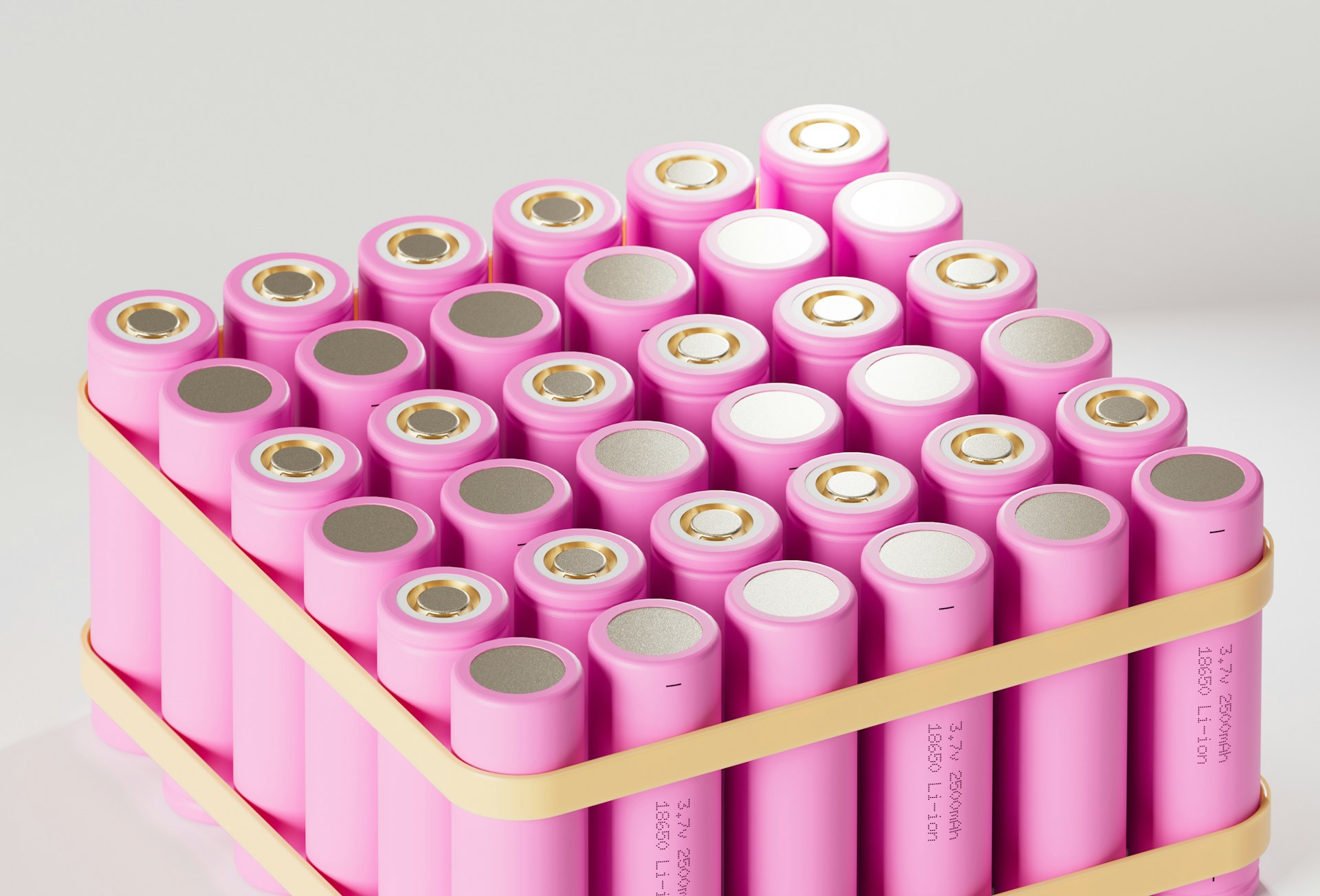
The story in four numbers
The betavoltaic battery demonstrated by Betavolt and the parallel Carbon-14 diamond battery programme at Northwest Normal University are not a challenge to lithium-ion as the dominant energy storage technology for consumer electronics. They are a solution to a specific and long-standing power problem that lithium-ion cannot address: the need to deliver continuous, maintenance-free electrical power for decades to devices implanted in the human body, deployed in deep space, embedded in military sensor networks, or installed in geophysical monitoring positions where recharging or replacement is medically risky, physically impossible, or operationally unacceptable. The firm reads Betavolt's BV100 specification, 100 microwatts for 50 years from a Nickel-63 cell smaller than a coin, as a technically credible prototype demonstration, not a near-term mass-market product. The path to commercial deployment runs through isotope supply chain development, regulatory frameworks for the handling and disposal of radioisotope material, and the clinical and aerospace qualification processes that govern acceptance in the highest-value target applications. None of these are insurmountable, and the commercial case in at least two application domains, cardiac implant power and autonomous remote sensing, is strong enough on the published specifications alone to justify the development investment currently underway.
Why beta decay is a power source, not a hazard
The concept of generating useful electricity from radioactive decay has been understood and experimentally demonstrated since the 1950s, and its commercial application in large-format radioisotope thermoelectric generators (RTGs) has powered deep-space probes including Voyager 1, Voyager 2, Cassini, and the Mars Science Laboratory Curiosity rover for decades. What Betavolt has achieved is not a new principle but a new form factor and a new safety architecture, a miniaturised device using isotopes whose radiation profile is fundamentally different from the plutonium-238 RTGs of NASA's spacecraft. The physics of a betavoltaic cell begins with beta decay: the spontaneous emission of an electron (a beta particle) from the nucleus of an unstable isotope as it transforms into a more stable element. In the case of Nickel-63, each decay event produces a low-energy electron and transforms the nucleus into Copper-63, a completely stable and non-radioactive element. The key word is low-energy: the beta particles emitted by Nickel-63 have a maximum energy of approximately 67 keV, which means they are stopped by a sheet of paper, a thin layer of plastic, or the outermost layer of human skin, and produce no gamma radiation, the penetrating electromagnetic emission that characterises the radiation hazard associated with nuclear reactors, X-ray machines, and the high-activity isotopes used in medical imaging. A betavoltaic cell captures these low-energy electrons by sandwiching the radioactive isotope between layers of semiconductor material, in Betavolt's design, a diamond semiconductor, that converts the electron kinetic energy into electrical current through the same semiconductor junction physics that governs a solar cell. The result is a continuous electrical output whose magnitude depends on the decay rate of the isotope (which follows the isotope's half-life, declining slowly over decades) and the efficiency of the semiconductor conversion layer. There is no combustion, no heat generation, no chain reaction, no chemical degradation cycle, and no thermal runaway, the failure mode responsible for the fire risk in lithium-ion batteries under stress. The radioactive material is fully encased in diamond or steel shielding, and no external radiation is detectable at normal operating distances. The safety profile of a betavoltaic cell is, by the physics of its operating principle, fundamentally different from the associations that the word nuclear carries in public discourse.
01 · The BV100 and the Carbon-14 diamond battery
Two distinct programmes define the current frontier of miniaturised nuclear battery development, each using a different isotope and a different design architecture, and each targeting a slightly different segment of the long-life micro-power market.
The BV100, developed by Betavolt Technology, a Beijing-based company, uses Nickel-63 as its radioisotope source. Nickel-63 has a half-life of approximately 100 years, meaning that over the device's specified 50-year operational life, its output declines to roughly 70% of its initial value, a gradual, predictable degradation profile that is fundamentally different from the step-function capacity loss characteristic of chemical batteries approaching end-of-life. The prototype specification published by Betavolt is 100 microwatts of continuous power output from a device with a footprint smaller than a standard coin cell battery. The semiconductor conversion layer in the BV100 uses synthetic diamond, which offers several properties relevant to betavoltaic applications: wide bandgap (enabling efficient conversion of the high-energy tail of the beta particle energy spectrum), radiation hardness (the diamond lattice does not degrade under prolonged beta irradiation as conventional silicon would), and the physical rigidity and biocompatibility that medical implant applications require. Betavolt has stated an intention to release a 1-milliwatt version of the device aimed at microelectronic devices including wearable health monitors, with a production release date not yet confirmed in published materials. The Carbon-14 diamond battery in development at Northwest Normal University in Gansu province operates on a different physical principle that is, if anything, more elegant than the BV100. Carbon-14, with a half-life of approximately 5,730 years, emits beta particles at lower energy than Nickel-63 (maximum ~156 keV, though the mean is lower). The Northwest Normal University programme embeds Carbon-14 atoms directly into synthetic diamond crystal structures, creating a device in which the radioactive source and the semiconductor converter are the same material: the beta electrons emitted by Carbon-14 nuclei within the diamond lattice are captured by the surrounding diamond semiconductor before they can escape the device, converting their kinetic energy directly into a charge carrier flow. The result, in the researchers' published concept, is a battery with an operational lifespan of 100 years and a self-contained, shielded architecture in which the radioactive material never needs to be extracted, replaced, or handled after the diamond is grown. The programme is described as in early laboratory stage with no published prototype specification equivalent to the BV100's 100 μW output, and any timeline to commercial deployment must be read against that status.
The physics of betavoltaic conversion has been understood since the 1950s. What Betavolt has achieved is not a new principle but a new form factor, a device small enough to sit inside a medical implant, durable enough to outlast the patient, and built from materials whose radiation profile bears no physical resemblance to the hazards that the word nuclear implies in public discourse.
| Technology | Operational lifespan | Power output (typical) | Primary applications | Key limitation |
|---|---|---|---|---|
| Lithium-ion (rechargeable) | 2-5 years (with recharging) | Watts to kilowatts | Consumer electronics, EVs | Requires recharging; degrades with cycles |
| Lithium primary (medical grade) | 5-10 years (low drain) | Microwatts to milliwatts | Pacemakers, implants | Surgical replacement required at end-of-life |
| Betavoltaic Ni-63 (BV100) | Up to 50 years | 100 μW (prototype) | Implants, sensors, space | Low power ceiling; isotope supply cost |
| Betavoltaic C-14 diamond (target) | ~100 years (target) | Micro-watt range (lab) | Implants, extreme-environment sensors | Lab stage; no prototype specification |
| RTG (Pu-238, space grade) | Decades | Watts to kilowatts | Deep-space probes, military | Regulated isotope; large form factor; cost |
02 · What 100 microwatts can and cannot power
The most important calibration for any assessment of betavoltaic battery commercial potential is an honest accounting of what 100 microwatts, the current BV100 prototype specification, can actually drive, and what it cannot. Conflating the two produces both overestimated and underestimated commercial projections, depending on the application domain being evaluated.
One hundred microwatts is approximately the power consumption of a modern cardiac pacemaker in continuous pacing mode, a figure that has been driven down over decades of medical device engineering precisely because the battery replacement surgery that a pacemaker's power source makes necessary every 5 to 10 years carries real procedural risk, particularly for elderly or high-risk patients. A pacemaker powered by a betavoltaic cell operating at the BV100 specification would, in the reported range of current prototype performance, eliminate the need for battery replacement surgery over a patient's lifetime in most implant scenarios, a clinical value proposition that requires no stretch of the current prototype specification to be compelling. The same 100 μW is sufficient to power a wide range of low-power microcontrollers in deep-sleep operating modes, MEMS sensors transmitting on a duty-cycle basis, GPS tracking modules in intermittent-acquisition mode, precision timing references for satellite and communications equipment, and the control logic of autonomous industrial sensors deployed in environments where maintenance access is constrained. What 100 μW cannot power, at current specification, is anything in the milliwatt-to-watt consumption range, which includes essentially all smartphones, hearing aids, continuous-transmission wireless sensors, and active computing platforms. Betavolt's stated 1-milliwatt development target, which is ten times the current prototype output and represents the power level required for hearing aids and continuous biosensors, is the threshold at which the addressable commercial market expands materially. The path from 100 μW to 1 mW in a betavoltaic cell is an engineering problem rather than a physics problem, it requires either a higher-activity isotope loading per unit area, a more efficient semiconductor conversion layer, or a larger device footprint, and Betavolt's public commitment to reaching that target is, in the firm's reading, the most commercially significant element of the programme description beyond the current prototype specification.
03 · The applications, medical, space, defence, and autonomous systems
The commercial application map for betavoltaic batteries is defined not by the devices that consume the most power but by the ones for which the inability to recharge or replace a battery represents the highest cost, measured in surgical risk, mission criticality, or operational inaccessibility.
The medical implant market is the most commercially immediate and the most clearly defined by the current BV100 specification. Cardiac pacemakers are the canonical application: approximately one million pacemakers are implanted globally per year, each powered by a lithium primary battery that requires surgical replacement every 5 to 10 years. The surgical replacement procedure carries complication risks, infection, lead damage, and the procedural risks associated with reopening the pocket, that are particularly significant in the elderly population that constitutes the majority of pacemaker recipients. A device powered by a betavoltaic cell at 50-year specification would eliminate the replacement procedure for virtually all implanted patients, reducing lifetime device cost and clinical risk simultaneously. The same logic applies to a broader range of implants currently powered by lithium primary cells: neurostimulators for chronic pain management and Parkinson's disease, cochlear implant processors, retinal prostheses, and the implantable cardioverter-defibrillators that protect high-risk cardiac patients from sudden death, all of which require periodic replacement surgery that betavoltaic power would eliminate or extend dramatically. The space and satellite application is the one with the longest established precedent for radioisotope power: NASA's deep-space probes have used Plutonium-238 RTGs since the 1960s. The betavoltaic cell's relevance in space is not for the multi-hundred-watt power budgets of large probes but for small satellites, CubeSats, and the increasingly distributed sensor networks of the emerging commercial space sector, where the power density and longevity of a betavoltaic cell at micro-watt to milliwatt scale addresses the constraint that limits small satellite operational life, battery degradation in the radiation environment of low Earth orbit, which accelerates the capacity decline of conventional lithium-ion cells beyond what the solar-charging cycle can compensate. The defence and military sensing application follows directly from the autonomous sensor logic: a sensor node deployed in a contested or remote environment that must operate for years or decades without maintenance, provides intelligence data through low-power radio transmission on a duty cycle, and cannot be serviced without exposing personnel or revealing operational intent represents the ideal operating profile for a betavoltaic power source. The United States, Russia, and United Kingdom all have active radioisotope energy programmes, and the military interest in betavoltaic technology has been a driver of government research funding in this domain for decades.
04 · The constraints, isotope supply, regulation, and public perception
The commercial timeline for betavoltaic batteries is not set by the physics of conversion efficiency or the engineering of the semiconductor junction, both of which are tractable, funded, and advancing. It is set by three constraints that operate outside the laboratory: the supply chain for the isotopes the batteries require, the regulatory framework governing the handling and commercialisation of radioisotope materials, and the public perception challenge inherent in marketing any device described as nuclear.
The isotope supply challenge is the most concrete near-term constraint. Nickel-63 is produced by neutron irradiation of enriched Nickel-62 in a nuclear reactor, a process that requires reactor access, isotope separation capability, and a production infrastructure that does not currently exist at the volumes a commercial betavoltaic battery industry would require. Current global production of Nickel-63 is estimated in the range of kilograms per year, primarily for industrial gamma-ray detector applications; a meaningful betavoltaic battery industry would require production capacity orders of magnitude larger to supply the medical device and consumer electronics markets that represent the commercial opportunity. Carbon-14, the isotope in Northwest Normal University's 100-year diamond battery concept, is more widely produced, it is generated as a byproduct of nuclear reactor operation, but the enrichment and purification to the levels required for diamond synthesis at commercial quality is a process whose scaling economics have not been established at relevant volumes. The regulatory framework governing the use of radioisotope materials in consumer and medical products is detailed, jurisdiction-specific, and not designed around the betavoltaic operating profile. Medical device regulatory approval in major markets requires extensive safety and biocompatibility testing for any novel power source in an implantable device, a process measured in years and tens of millions of dollars. Transport regulations for radioisotope materials, even those with the low-activity profiles of Nickel-63 and Carbon-14, require specific permits, packaging standards, and carrier authorisations that add friction to global supply chain operations. Public procurement, particularly in medical device markets, also reflects perception risk: the word nuclear on a consumer or medical product label carries associations that are unrelated to the actual radiation profile of a betavoltaic cell but that are operationally relevant for any commercial product requiring patient or consumer acceptance. The engineering answer to the safety question, no penetrating radiation, no heat, no chain reaction, decay product is stable copper or nitrogen, is technically complete; the communication answer requires a different kind of investment.
The constraints on betavoltaic commercialisation are not physics constraints, the conversion principle is sound, the materials are manufacturable, and the safety case is complete. They are supply chain, regulatory, and perception constraints, each of which is solvable on a multi-year timeline by a company or government programme with sufficient capital and institutional relationships. The question is which application domain produces sufficient commercial value to justify the investment in solving all three simultaneously.
The cardiac pacemaker replacement burden is the clearest commercial target for betavoltaic technology at the current 100 μW specification. The value proposition is direct and measurable: each surgical battery replacement carries documented procedural risk, anaesthetic cost, and patient recovery time, and the population of pacemaker patients, disproportionately elderly and often medically fragile, is the one for whom that risk is highest. Medical device companies including Medtronic, Abbott, and Boston Scientific have existing pacemaker product lines, regulatory relationships, and clinical evidence infrastructure that would be directly applicable to a betavoltaic-powered replacement product. The barrier is regulatory qualification of the new power source and, critically, the isotope supply chain for Nickel-63 at the volumes required for a production medical device programme. If Betavolt or a partner can establish a qualified Nickel-63 supply chain and navigate the regulatory pathway, a process that, in the cardiology implant market, runs through FDA and CE marking and requires multi-year clinical evidence, the medical implant market represents a first-mover opportunity with a defensible clinical and commercial case.
The autonomous sensor and IoT application, defence sensor networks, geophysical monitoring, smart infrastructure in access-constrained locations, represents a larger eventual addressable market than medical implants but a longer commercial timeline. The applications are technically well-matched to the 100 μW specification; the constraints are regulatory (radioisotope handling in distributed field deployment) and commercial (cost per device at volume must be competitive with conventional battery-plus-maintenance economics, which in many industrial IoT applications runs to very low unit prices). Betavolt's stated move toward a 1 mW commercial product, if achieved at a price point competitive with the alternative of a replaceable lithium primary battery plus the service cost of periodic replacement missions, would substantially expand the addressable market. The defence application, where cost per device is less constrained and the operational advantage of indefinitely maintenance-free remote sensing is most directly valued, is likely to precede the civilian IoT deployment at scale.
The power problem betavoltaics actually solve
The commercial significance of Betavolt's BV100 and the Carbon-14 diamond battery programme is not that they challenge lithium-ion as the dominant technology for portable power, they do not, and were never designed to. Their significance is that they solve a specific and long-standing power problem that chemical batteries cannot: the need for continuous, maintenance-free electrical power delivered over decades to devices that cannot be recharged and whose replacement carries clinical, operational, or physical costs that are disproportionate to the energy they require. The BV100's 100-microwatt specification closes the pacemaker replacement surgery problem, eliminates the maintenance cycle for a wide range of remote monitoring sensors, and provides a power source whose longevity exceeds the design life of the devices it powers. The Carbon-14 diamond battery, if it achieves commercial form, extends that logic by a factor of two, to a device that could, on the published specification target, outlast the patient, the satellite, or the sensor installation it powers by generations.
The commercial path is not straightforward: isotope supply chain development, regulatory qualification in the medical device and aerospace domains, and the communication investment required to separate betavoltaic physics from nuclear association in the minds of procurement decision-makers represent a multi-year and multi-hundred-million-dollar programme. China appears, based on the Betavolt demonstration and the Northwest Normal University programme, to have established a development lead in miniaturisation, a lead that the US, UK, and Russian programmes acknowledged by the source reporting as active in radioisotope energy have not yet publicly matched on form factor. Whether that lead translates into first-to-market advantage in the medical device applications that represent the highest near-term commercial value will depend as much on regulatory strategy and supply chain investment as on further prototype refinement.
The firm reads the Betavolt BV100 demonstration as a technically credible prototype that has crossed the threshold of commercial relevance in at least two application domains, cardiac implant power and autonomous remote sensing, without yet having addressed the supply chain, regulatory, and perception constraints that govern the timeline to commercial deployment. The battery that will eliminate pacemaker replacement surgery exists in prototype form. The infrastructure to manufacture, regulate, and deploy it at scale does not yet exist. The gap between the two is the commercial opportunity.
Sources: Engineerine.com (engineerine.com); Betavolt Technology programme disclosures; Northwest Normal University published research on Carbon-14 diamond battery; US Nuclear Regulatory Commission radioisotope source regulations; FDA medical device power source guidance; published betavoltaic conversion efficiency research (Journal of Applied Physics, IEEE Transactions on Electron Devices); NASA RTG programme documentation. This note is for informational purposes only and does not constitute investment advice.