
The story in four numbers
The next generation of commercial aircraft will not be defined by a single breakthrough design but by the selective commercial adoption of four parallel innovation vectors, each advancing at a different rate and each facing a different category of constraint. Propulsion architecture, the shift from kerosene combustion toward open fan, hybrid-electric, and ultimately hydrogen propulsion systems, is the most commercially proximate transformation and the one with the deepest structural implications for aircraft range, payload, and airframe geometry. Aerodynamic architecture, represented primarily by the blended wing body form factor and its documented efficiency advantages, is the most physically compelling but the most commercially complex, requiring changes to manufacturing infrastructure, terminal design, and passenger cabin geometry that extend its commercial timeline well beyond the propulsion transition. Urban air mobility and supersonic reentry represent targeted market plays rather than replacements for the core commercial aviation stack, with commercial viability dependent on regulatory frameworks and infrastructure investments that are in progress but not yet complete. The firm's framework holds that the designs closest to the production gate are those that operate within the existing certification and infrastructure envelope while materially improving propulsion efficiency, and that the architectures requiring new regulatory categories, new airport infrastructure, or new energy distribution networks will follow on a decade-longer horizon, regardless of their technical maturity.
Why this generation of aircraft design is different
Every generation of commercial aircraft design has been shaped by the dominant constraint of its moment. The jet age of the 1950s and 1960s was shaped by the step-change in cruise speed and altitude that turbine propulsion enabled and by the manufacturing scale required to produce aluminium fuselage structures in volume. The wide-body era of the 1970s was shaped by the economics of high-density long-haul routes and the structural engineering required to build aircraft large enough to make them viable. The composite era of the 2000s, represented by the Boeing 787 Dreamliner and Airbus A350, was shaped by the fuel economics argument for lightweight carbon fibre structures and the manufacturing learning curve required to produce them reliably at airline scale. The current generation of advanced aircraft designs is shaped by a convergence of pressures that is unprecedented in their simultaneous intensity: a regulatory and commercial imperative to decarbonise aviation propulsion that has no viable near-term solution in any single technology; a digital manufacturing capability that for the first time makes aerodynamically optimal but geometrically complex forms manufacturable at scale; a venture capital cycle that funded several dozen urban air mobility programmes simultaneously and is now forcing a consolidation that will determine which of those programmes survives to certification; and a supersonic regulatory environment that is, for the first time since the Concorde's retirement in 2003, moving toward the possibility of overland supersonic commercial flight. The interaction of these pressures is not producing a single transformative aircraft design but a diversified portfolio of architecture experiments, each optimised for a different segment of the air transport market and each carrying a different profile of technical, regulatory, and commercial risk.
01 · Propulsion architecture, the primary design variable
Propulsion is the primary design variable for the next generation of commercial aircraft not because the other dimensions are less important but because propulsion efficiency determines fuel consumption, which determines operating economics, which determines which aircraft types operators order and which airlines retire. Every commercial aircraft architecture that reaches production scale in the next twenty years will be evaluated first by its propulsion system's efficiency and environmental performance.
The near-term propulsion transition, the one already underway, does not require a new aircraft architecture. Sustainable aviation fuel (SAF), produced from biomass, waste streams, or power-to-liquid synthesis processes, is chemically compatible with existing turbofan engines and existing aircraft airframes; its decarbonisation value depends on the lifecycle carbon intensity of its feedstock and production process, and its commercial constraint is supply volume and cost premium relative to conventional jet fuel rather than engine or airframe certification. Airlines and regulators have agreed on SAF as the dominant near-term decarbonisation mechanism for commercial aviation, and the technology is already in scheduled commercial service. The medium-term transition is represented most concretely by the CFM RISE (Revolutionary Innovation for Sustainable Engines) open fan programme, a joint development between GE Aerospace and Safran that targets a roughly 20% improvement in fuel efficiency relative to the LEAP turbofan engines that power the current generation of Boeing 737 MAX and Airbus A320neo aircraft. The open fan architecture, placing the fan blades outside the engine nacelle rather than enclosed within it, improves propulsive efficiency by increasing the bypass ratio beyond what conventional nacelle geometry permits, at the cost of a noise signature and installation geometry that introduce new certification and integration challenges. CFM is targeting entry into service in the late 2020s or early 2030s, and its adoption would be, if the performance and noise targets are met, the most commercially significant propulsion efficiency step since the high-bypass turbofan era of the 1970s. The long-term transition, the one that requires the most new infrastructure and the most new aircraft engineering, is hydrogen propulsion, pursued in two forms: direct hydrogen combustion in a modified gas turbine (the approach Airbus is investigating under the ZEROe programme) and hydrogen fuel cell propulsion combined with electric motors (the approach pursued by ZeroAvia for regional aircraft applications). Liquid hydrogen's volumetric energy density is approximately one-quarter that of conventional jet fuel, meaning that hydrogen-powered aircraft require approximately four times the tank volume for the same energy content, a constraint that forces fundamental changes to airframe geometry, preferring wide fuselage designs (such as a blended wing body) that can accommodate large cryogenic hydrogen tanks without the penalty of extended fuselage length. The infrastructure constraint, airport hydrogen storage, liquefaction, and distribution systems, means that the timeline for hydrogen aviation is governed not only by airframe and engine certification but by the pace of airport infrastructure investment, which no airline or aircraft manufacturer controls directly.
The aircraft that will define the 2030s has already been certified, it is a refined tube-and-wing design powered by an open fan engine burning sustainable aviation fuel at a lower cost per seat-mile than anything currently in service. The architecture that will define the 2040s is on a test pad today, but the certification timeline, airport infrastructure, and energy distribution network it requires will take longer to build than the aircraft itself.
02 · Aerodynamic form, the blended wing body case and what it requires
The tube-and-wing configuration that has defined commercial aircraft since the de Havilland Comet and Boeing 707 is not the aerodynamically optimal form for a large aircraft. It is the form that was easiest to manufacture, certify, and integrate with existing airport infrastructure when commercial aviation scaled in the 1950s and 1960s, and those historical path dependencies have been embedded in every subsequent generation of aircraft design, terminal layout, and certification regulation.
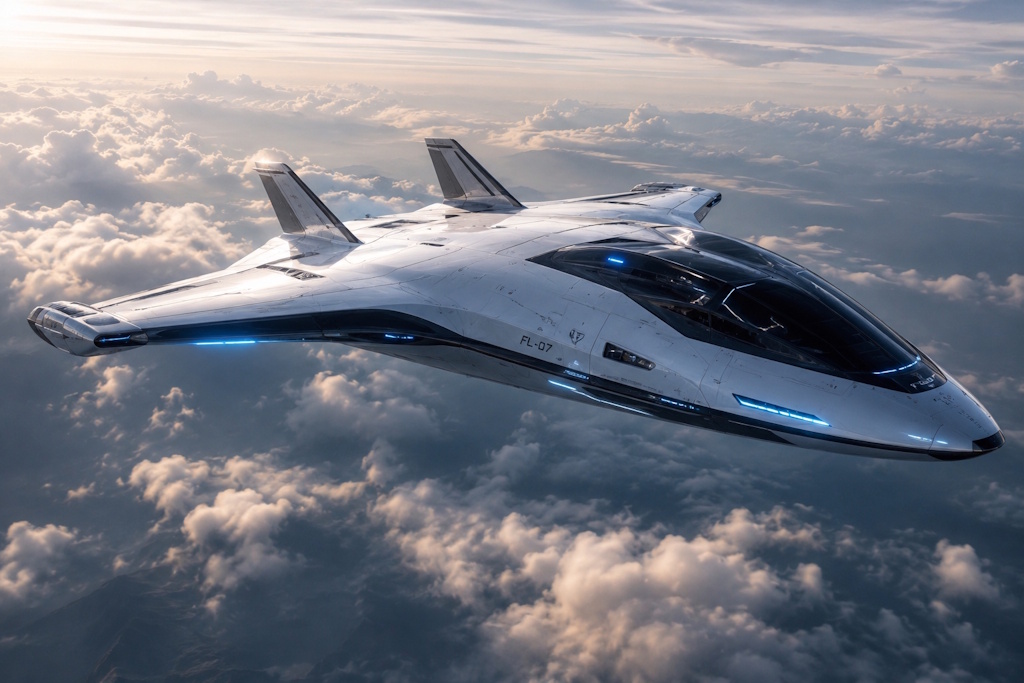
The blended wing body (BWB) configuration, in which the wing and fuselage merge into a single continuous lifting surface rather than a cylindrical body attached to a separate wing structure, has been demonstrated computationally and in subscale flight tests to offer lift-to-drag ratio improvements in the range of 20-40% relative to conventional tube-and-wing aircraft of equivalent payload. This efficiency gain is not primarily an innovation; it is a geometry that aeronautical engineers have understood since at least the 1940s and that the Northrop B-2 Spirit bomber has demonstrated at full scale since 1989. The reason it has not entered commercial service is not aerodynamic uncertainty but structural, certification, and operational complexity. A BWB passenger cabin is non-cylindrical, most passengers sit far from windows in a wide, shallow space, and emergency evacuation routes, pressurisation loads, and structural frame design for a non-circular cross-section all require new engineering solutions that have not been proven at commercial scale. Terminal infrastructure presents an additional barrier: BWB aircraft are significantly wider than current widebody aircraft and would require modified gate equipment, boarding bridges, and taxiway clearances at most of the world's major hub airports. The programmes advancing BWB most concretely toward commercial application are JetZero, a US-based startup that has received a US Air Force contract for a BWB tanker demonstrator and is developing a commercial version, and Airbus's MAVERIC (Model Aircraft for Validation and Experimentation of Robust Innovations in Configuration) demonstrator, which completed an internal test programme in 2021. Neither is close to commercial certification, and the firm's assessment is that a commercial BWB narrowbody or widebody is a 2035-2045 proposition, with the timeline governed as much by airport infrastructure standardisation as by aircraft certification. What the BWB case demonstrates, and this is the analytical value of following its progress, is that the largest efficiency gains available to commercial aviation designers sit outside the existing certification and infrastructure envelope, and that reaching them requires a coordinated transformation of airports, regulations, and manufacturing that no single company can drive unilaterally.
| Design vector | Representative programme | Propulsion type | Target EIS | Primary constraint |
|---|---|---|---|---|
| Open fan turbofan | CFM RISE (GE Aerospace / Safran) | Open fan + SAF compatible | Late 2020s / early 2030s | Noise certification, nacelle integration |
| Hydrogen turbofan | Airbus ZEROe | LH2 combustion + turbine | 2035 (target) | Tank volume, airport H2 infrastructure |
| Hydrogen fuel cell | ZeroAvia HyFlyer | H2 fuel cell + electric motor | 2027-2028 (regional) | Power density scalability, cost |
| Battery-electric (regional) | Eviation Alice | Battery + electric motor | Certification in progress | Energy density, range ceiling (~440 nm) |
| eVTOL (UAM) | Joby Aviation, Archer Midnight | Battery + electric rotors | 2025-2026 (targeted) | FAA Part 135 certification, vertiport build |
| Blended wing body | JetZero, Airbus MAVERIC | Advanced turbofan / H2 | 2035-2045 | Airport infrastructure, cabin certification |
| Supersonic commercial | Boom Overture | SAF turbofan (Symphony) | 2029 (target) | Overland sonic boom regulations, market size |
03 · Urban air mobility and the eVTOL certification reality
The urban air mobility sector attracted more investment capital between 2019 and 2024 than any other segment of advanced aviation, funded by the premise that electrically powered vertical take-off and landing aircraft could provide a commercially viable alternative to ground transportation in dense urban environments. The certification reality, slower, more expensive, and more operationally constrained than most of that capital was priced for, is now producing the consolidation that characterises every technology sector whose commercialisation timeline outran its investment cycle.
The eVTOL (electric vertical take-off and landing) concept addresses a specific and real market: short-distance urban and suburban point-to-point transportation at a time and cost threshold that commercial helicopter operations cannot sustainably serve. The physics of battery-electric propulsion at the scale required for a four-to-six-passenger aircraft are not the primary constraint, multiple programmes have demonstrated sustained flight at meaningful payload, and the battery energy density required for 50-100 km urban routes is achievable with current and near-term cell technology. The constraints are regulatory, operational, and infrastructural. Regulatory: FAA certification of eVTOL aircraft under a new Special Class category requires demonstrating safety standards comparable to existing commercial aviation, and the novel architectures, distributed electric propulsion with multiple redundant rotors, fly-by-wire at a scale and response rate without precedent in certified aviation, require extensive testing and documentation that has consistently extended from initial programme timelines. Joby Aviation and Archer Aviation are the two US programmes most advanced in FAA certification, and both have disclosed certificate timelines that extend further into the mid-2020s than original investor communications indicated. Infrastructure: the commercial model for eVTOL depends on vertiports, dedicated take-off and landing facilities in urban environments that provide the frequency and throughput required to generate meaningful ridership, and vertiport construction requires regulatory approval, real estate, noise agreements, and grid power connection that no aircraft manufacturer can accelerate independently. The consolidation currently underway, which has already claimed Lilium (bankrupt in 2023 before relaunching under new ownership), Vertical Aerospace (restructured), and a number of smaller programmes, will produce a smaller set of better-capitalised operators with credible certification paths, but the market that emerges will be narrower than the 70-plus-programme investment cycle assumed, concentrated on airport-to-city and inter-city corridors where the time-savings case over ground transport is clearest and where anchor customers (airlines, ride-share operators, cargo) can provide the volume commitment that makes vertiport infrastructure economically viable.
The eVTOL investment wave of 2019 to 2023 produced more programmes than the global air transport system has vertiports to accommodate. The question was never whether electrically powered urban air mobility is physically possible, demonstrated flight settles that, but whether the certification timeline and infrastructure build rate can support the returns that the capital raised in that wave was priced for. The answer, increasingly, is that they can support some of those returns, for some of those programmes, in some of those markets.
04 · Supersonic reentry and the regulatory architecture it requires
Commercial supersonic aviation has been absent from scheduled service since British Airways and Air France retired the Concorde in 2003, not because the physics of supersonic passenger flight are unsolved but because the economics of the Concorde's operating profile, and the regulatory prohibition on overland supersonic flight that restricts it to transatlantic and transpacific routes, have made commercial supersonic aviation unviable at the fleet scale required to support sustainable airline economics.
Boom Supersonic's Overture is the most commercially advanced attempt to re-enter this market in the post-Concorde period. Designed to carry 65 to 88 passengers at Mach 1.7, powered by four Symphony turbofan engines developed with StandardAero and optimised for 100% sustainable aviation fuel, and targeting entry into service in 2029, Overture has accumulated more than 130 orders and options from United Airlines, American Airlines, and others, a substantial commercial signal in an industry where orders represent genuine capital commitment, though Boom's own timeline history warrants the qualifier that 2029 targets for a programme at demonstrator stage carry execution risk that airline options are priced to reflect. The XB-1 technology demonstrator broke the sound barrier in its first supersonic flight in 2024, validating the core propulsion and aerodynamic approach at subscale. The fundamental commercial constraint on Overture and any future supersonic programme is not the aircraft, it is the route network. The supersonic sonic boom produced during level supersonic cruise generates ground-level noise that the FAA has prohibited over US territory since 1973, and equivalent prohibitions exist in most other major aviation markets. A commercial supersonic aircraft restricted to overland subsonic cruise and supersonic flight only over water is limited to a small number of transatlantic and transpacific routes where flight time savings are large enough to command the ticket price premium that supersonic operations require. The regulatory path to overland supersonic operations runs through NASA's X-59 QueSST (Quiet SuperSonic Technology) demonstrator, an aircraft designed and built by Lockheed Martin specifically to demonstrate that low-boom supersonic flight, generating a quiet thump rather than a startling sonic boom at ground level, is achievable with current aerodynamic technology. NASA's programme, which completed initial flight tests in 2024, is designed to generate the measured boom data that FAA and ICAO would require to establish new sound standards permitting commercial overland supersonic flight. The timeline for that regulatory process is measured in years from when NASA delivers its community response data to the FAA, which puts overland supersonic commercial operations firmly in the 2030s as an earliest credible horizon, even if the Overture or a successor aircraft achieves its stated 2029 certification date for transoceanic routes.
The most commercially proximate transformation in aircraft design is not a new airframe architecture but a new propulsion system on a conventional one. The CFM RISE open fan engine, if it achieves its targeted approximately 20% fuel efficiency improvement and its noise certification targets, will represent the most significant propulsion efficiency step in commercial aviation since the introduction of high-bypass turbofans in the 1970s, and it will do so while fitting onto existing narrow-body and wide-body airframe families with modifications rather than requiring wholly new aircraft. Airlines operating 737 MAX and A320neo fleets with LEAP engines would see a material improvement in seat-mile fuel cost with a RISE-powered successor, and the certification path runs through established Part 25 regulations rather than new special categories. Combined with SAF adoption for lifecycle carbon reduction, the open fan propulsion path represents the highest near-term probability of material aviation efficiency improvement at commercial fleet scale, not because it is the most ambitious design vector but because it is the one that most closely fits the existing commercial aviation ecosystem.
The hydrogen propulsion path, whether through liquid hydrogen combustion in a modified turbine or hydrogen fuel cell electric propulsion, represents the largest potential decarbonisation step available to commercial aviation and the one most dependent on infrastructure that does not yet exist at commercial scale. Airbus has committed publicly to its 2035 ZEROe target, and the engineering programmes to develop hydrogen combustor technology and cryogenic tank design are underway. The question the 2035 date cannot answer is whether liquid hydrogen fuelling infrastructure will be available at the airports, and on the routes, where a hydrogen-powered aircraft would need to operate commercially. The airports most likely to commission hydrogen infrastructure first are large hub airports where the capital investment is spread across high passenger and aircraft volume; but a narrowbody hydrogen aircraft's commercial value is precisely in the shorter-range, higher-frequency, point-to-point routes where medium and smaller airports are the relevant infrastructure. The coordination problem between aircraft certification and airport infrastructure investment is the central risk factor for the hydrogen aviation timeline, and it is a risk that aircraft manufacturers cannot resolve through engineering effort alone.
Which designs reach the gate, and when
The analytical framework for evaluating advanced aircraft design programmes requires holding two distinct assessment criteria simultaneously: technical maturity, which determines whether a design can be built and certified; and ecosystem readiness, which determines whether the infrastructure, regulation, and operational environment required to make the design commercially viable are in place when the aircraft is ready to fly. A design that is technically mature but ecosystem-constrained is not closer to commercial service than a design that is technically earlier but ecosystem-compatible, and the history of commercial aviation is full of technically superior concepts that lost to operationally compatible ones because the latter could enter service within the existing airport, regulatory, and maintenance ecosystem rather than requiring its transformation.
Applying this framework to the four design vectors produces a sequenced commercial timeline. Open fan propulsion, combined with SAF on existing or evolved airframe architectures, is the highest-probability near-term transformation because it is both technically advancing and ecosystem-compatible. Battery-electric regional and eVTOL programmes are close to certification in their target markets but commercially constrained by vertiport infrastructure and the short range ceiling imposed by current battery energy density. Supersonic commercial aviation is technically within reach, the demonstrator flights have been completed, but commercially gated by the overland regulatory regime that NASA's X-59 programme is designed to unlock over a multi-year regulatory timeline. Hydrogen turbofan for commercial narrowbody operations is the highest-potential but longest-timeline vector, governed by an infrastructure coordination problem that no single actor in the aviation value chain controls. Blended wing body commercial aircraft, despite their compelling aerodynamic efficiency case, face the most complex transition of all four vectors, requiring simultaneous changes to aircraft geometry, cabin certification, manufacturing infrastructure, and airport terminal design before commercial service is viable. The designs that will define the 2030s are the ones that fit most cleanly into the existing commercial aviation ecosystem while materially improving on its performance; the designs that will define the 2040s are the ones currently waiting for that ecosystem to be rebuilt around them.
The firm reads the current generation of advanced aircraft design programmes not as a competition between architectures but as a portfolio of ecosystem bets, each programme is a wager that its specific combination of aircraft technology and required infrastructure will converge within a commercially viable timeline. The designs closest to the production gate are those that placed the smallest bets on ecosystem transformation. The designs most likely to define aviation's long-term trajectory are those placing the largest ones.
Sources: Airbus ZEROe programme documentation; Boom Supersonic XB-1 and Overture programme filings; CFM International RISE programme technical disclosures; GE Aerospace open fan research publications; NASA X-59 QueSST programme documentation (NASA Armstrong Flight Research Center); JetZero programme disclosures; ZeroAvia HyFlyer programme; FAA eVTOL Special Class certification framework; Joby Aviation and Archer Aviation SEC filings; published aeronautical engineering analysis of blended wing body efficiency (AIAA and RAeS literature). This note is for informational purposes only and does not constitute investment advice.