
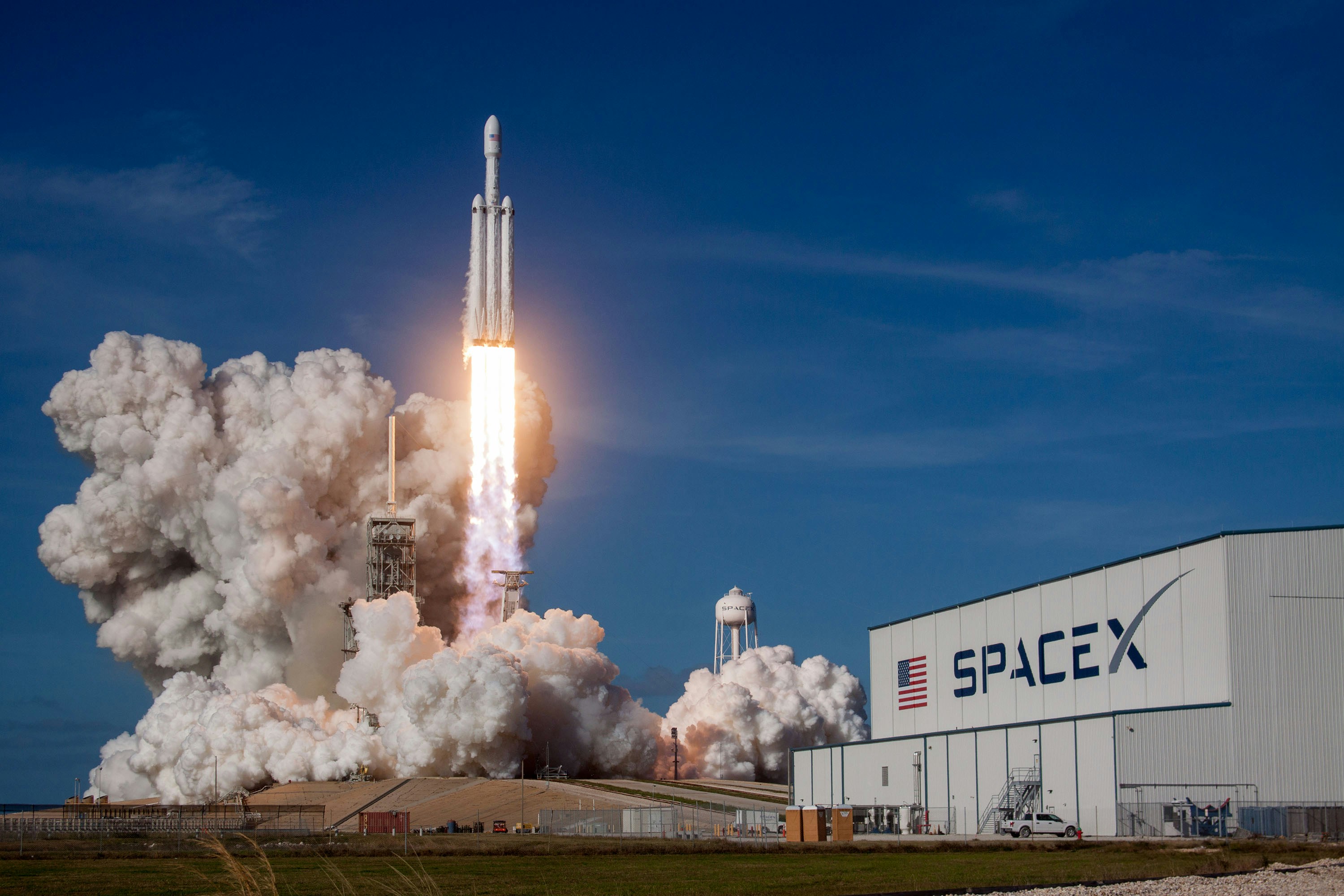
The position in four numbers
The firm's SpaceX position is anchored in one observation that we believe is systematically under-appreciated by the equity market: SpaceX is not a rocket company with a broadband side project — it is a vertically integrated infrastructure conglomerate whose launch business, once the primary valuation driver, is becoming the lowest-multiple component of a three-business sum of parts that includes a global satellite broadband network whose unit economics improve with every subscriber added to a fixed-cost constellation, and a data centre leasing operation whose physical infrastructure is deployed in orbit at a launch cost that no competitor can currently replicate. The compute landlord model that SpaceX's Q2 2026 earnings confirmed — with Anthropic and Google as anchor tenants in multi-year data-centre agreements — is the variable that, in our framework, changes SpaceX from a company whose valuation is bounded by aerospace multiples to a company whose valuation should be bounded by infrastructure and cloud multiples applied to a business whose physical plant was built by the same launch reuse economics that gave SpaceX its aerospace competitive moat. The entry timing is post-IPO and post-Q2 earnings, which means the market has had the compute landlord information for approximately one quarter — our assessment is that one quarter is not enough time for the equity market to fully recalibrate a SpaceX valuation model built around launch and broadband to incorporate a third business line whose comparable multiples are 40–100% higher than aerospace comparables on a revenue basis.
The position, marked daily
The chart below tracks the firm's SpaceX position against its $108.00 average entry, marked to the daily closing price of SpaceX (NASDAQ: SPCX).
What the Q2 2026 earnings confirmed — and why the timing of our purchase matters
The firm's SpaceX exposure has been an ongoing analytical project rather than a reactive trade. We published our first structured SpaceX thesis note in the week following the Q2 2026 earnings release, establishing a scenario-based valuation framework for the three-business sum of parts and identifying the compute landlord model as the variable most likely to drive a re-rating of the company's equity if confirmed at commercial scale. The note — available to the firm's clients at the link cited in this piece's sources line — set out the Anthropic and Google tenancy as analytically distinct from Starlink's consumer and enterprise broadband subscribers, because the data-centre tenancy relationship carries a different revenue recognition profile (long-term contracted, predictable, capacity-based rather than usage-based in the near term), a different churn risk profile (hyperscaler clients face massive switching costs once their workloads are running in a specific data centre's topology), and a different competitive sensitivity (the physical infrastructure is in orbit and was built at a launch cost that makes replication by any potential competitor a multi-year and multi-hundred-billion-dollar undertaking). Our conviction to establish a heavy position in the week following that publication reflects the time-sensitivity of the opportunity: the market's standard cadence for re-rating a newly disclosed business model is two to four quarters from first disclosure, meaning that investors who establish positions within one quarter of the first concrete confirmation of a structural earnings driver historically capture the majority of the multiple expansion that follows full analyst model revision. We assess the current period — one quarter post-Q2 confirmation, before the majority of sell-side models have been revised to incorporate a three-business-segment SpaceX — as falling squarely within that window.
01 · The compute landlord model — why SpaceX's data centre business changes the valuation framework
The compute landlord model is the conceptual frame the firm uses to describe SpaceX's data-centre tenancy business — a business whose defining characteristic is that the physical infrastructure (the satellites that host compute capacity in orbit) was deployed using launch vehicles that SpaceX manufactures and operates at a cost-per-kilogram-to-orbit that is, on a scenario-based estimate, approximately 5–15 times lower than any current or near-term competitor, creating a physical-layer competitive moat that is structurally different from the software-defined advantages that characterise terrestrial cloud infrastructure competition.
The analytical significance of the compute landlord framing is that it forces a comparison to the correct peer group. Amazon Web Services, Microsoft Azure, and Google Cloud — the hyperscaler cloud infrastructure providers — trade at P/S multiples in the range of approximately 8–20x on normalised revenue, reflecting the market's assessment of their recurring, high-margin, infrastructure-lease-equivalent revenue streams. If SpaceX's data-centre tenancy business generates revenue at a comparable margin profile — which the firm's scenario-based analysis treats as likely given the near-zero marginal cost of adding compute tenants to an already-deployed orbital constellation — then applying aerospace multiples (P/E of 15–25x on much lower margins) to the totality of SpaceX's revenue is a systematic category error, not a conservative valuation approach. The Q2 2026 earnings confirmed two structural features of the compute landlord model that our prior scenarios had treated as plausible but unconfirmed. First, the Anthropic and Google tenancy is multi-year and contractually anchored — this is not a pilot programme or a letter of intent but a commercial agreement whose revenue is being recognised and disclosed in formal earnings reporting. Second, the revenue contribution from compute was meaningful enough to be cited as a driver of the year-over-year revenue doubling, suggesting that the compute segment has moved beyond the immaterial-segment threshold at which it could be ignored in modelling exercises and into a range that requires explicit treatment in any forward-looking earnings model. The competitive analysis that underpins the compute landlord thesis rests on two load-bearing observations that we read as durable rather than ephemeral. The first is that the cost of deploying compute infrastructure in orbit — satellites, launch, integration — has a floor set by SpaceX's own Falcon 9 and Starship launch economics, and that floor is materially lower for SpaceX than for any entity that must purchase launch services from SpaceX or from a higher-cost alternative. The second is that orbital compute has latency and coverage characteristics that are genuinely different from terrestrial data centres — specifically for customers whose workloads require global coverage with sub-second response times, AI inference at the network edge over geographic areas not served by terrestrial data centre clusters, and secure communications applications where the physical separation of compute from terrestrial networks is an architectural requirement rather than a preference. These characteristics define a niche that is not directly competed by hyperscaler terrestrial infrastructure and that, in our assessment, will expand as AI inference workloads proliferate geographically into markets underserved by terrestrial cloud infrastructure.
We assess the compute landlord model as the most significant undiscounted value driver in the SpaceX equity story — not because the satellite data-centre business will necessarily displace terrestrial hyperscalers, but because its marginal cost of scale, once the orbital infrastructure is deployed, approaches zero in a way that terrestrial infrastructure expansions do not. That cost structure, applied to a growing global demand for AI inference capacity, is the compound growth engine that makes SpaceX a different kind of position than its aerospace peer group would suggest.
02 · The sum-of-parts framework — valuing three separate businesses at one blended entry price
The firm's SpaceX valuation methodology applies segment-specific multiples to each of the three distinct business lines — launch services, Starlink broadband, and Starlink Data Centres compute tenancy — and assesses whether the resulting sum-of-parts intrinsic value range, at our confidence-bounded revenue and margin assumptions, represents a meaningful discount or premium to current market levels. Our conclusion, stated directly, is that current market pricing represents a scenario-based discount to intrinsic value that is large enough to justify the position size we have established.
The launch services business is the most analytically tractable component because it has the longest operating history, the most public comparable data (United Launch Alliance, Rocket Lab, Arianespace), and the most clearly bounded competitive dynamics. On scenario-based estimates for SpaceX's 2026 launch revenue — informed by the public manifest of contracted missions, the Starship Commercial Programme cadence, and the Department of Defense launch contracts that are publicly disclosed at the contract-award stage — the firm applies a P/E multiple in the confidence-bounded range of 18–25x that reflects SpaceX's market share leadership (approximately 65–70% of global commercial orbital launches in the researchers' reported range for 2025–2026), its cost-per-kilogram advantage (Falcon 9 reuse economics have driven launch costs below $2,000 per kilogram to LEO under scenario-based estimates), and its near-term competitive positioning against Blue Origin's New Glenn and other new-entrant vehicles. This business alone, at the low end of the multiple range, produces a per-share intrinsic value estimate that anchors the downside scenario for the overall position. The Starlink broadband business is valued using a telecommunications and satellite ISP comparable peer set — Viasat, HughesNet, and, where applicable, MVNO and fixed-wireless operators with similar ARPU profiles. On the firm's scenario-based Starlink subscriber and ARPU assumptions — the subscriber base in the confidence-bounded range of 8–15 million active accounts as of mid-2026, ARPU in the confidence-bounded range of $80–$130 per month across residential, maritime, aviation, and enterprise tiers — we model EBITDA margins approaching terrestrial fixed-wireless comparables as the constellation reaches full coverage density and per-satellite unit costs decline through Starship-enabled mass production of second-generation satellites. An EV/EBITDA multiple in the range of 12–20x applied to scenario-based normalised EBITDA produces a per-share contribution that, combined with the launch business value, exceeds the launch-only anchoring case by a meaningful margin. The compute landlord business is the scenario-range variable with the widest dispersion and therefore the highest contribution to both the upside scenario and the uncertainty in our point estimate. We apply a P/S multiple in the range of 8–18x to scenario-based revenue estimates anchored by the confirmed Anthropic-Google tenancy, extrapolated to include additional tenancy from AI infrastructure operators whose workloads are candidates for the orbital compute architecture. The confidence-bounded estimate of this business's current revenue run rate — and the scenario range of its trajectory over the next three to five years — is the primary variable on which the position's upside depends, and it is the variable we have the least public data to constrain with precision.
| Segment | Revenue basis | Applicable multiple (scenario range) | Peer group rationale | Value contribution vs. aerospace-only baseline |
|---|---|---|---|---|
| Launch Services | Contracted launch manifest; DoD awards | P/E 18–25x (scenario) | ULA, Rocket Lab, Airbus Defence; market-share premium applied | Baseline (1.0x) — anchors downside floor |
| Starlink Broadband | ~8–15M subscribers × ARPU (scenario) | EV/EBITDA 12–20x (scenario) | Viasat, fixed-wireless MVNOs; maritime/aviation tier premium | +40–80% above launch-only value (scenario) |
| Starlink Data Centres (compute) | Anthropic + Google tenancy; scenario expansion | P/S 8–18x (scenario) | AWS, Azure, Equinix; orbital moat premium | +50–150% above launch+broadband (upside scenario) |
| Blended SpaceX | Sum of above at scenario-based weights | Implied blended 14–25x P/S (scenario) | Structural transition from aerospace to infrastructure | Scenario-based discount to current market levels at base case |
03 · The risk matrix — what actually threatens the position versus what the market obsesses over
The firm's risk assessment distinguishes between risks that would materially change our thesis and valuation framework and dynamics that attract significant market and media attention but that, in our assessment, do not alter the underlying drivers of the position. Conflating the two categories is the primary source of forced selling at the wrong moment in a high-conviction position.
The risks that the firm assesses as genuinely thesis-threatening fall into two categories. The first is launch cost convergence: if a new entrant — Blue Origin with New Glenn, RocketLab with Neutron, or a state-backed non-US programme — achieves launch costs that close to within 30–40% of SpaceX's current Falcon 9 economics, the competitive moat on the launch services business narrows, the replication cost of the orbital compute infrastructure falls, and the compute landlord's pricing power decreases. Our scenario-based assessment places the probability of this outcome within a three-to-five-year horizon as relatively low — achieving Falcon 9-comparable economics requires not just vehicle development but the demonstrated reuse rate that SpaceX has built over hundreds of missions — but it is not zero, and it is the risk we monitor most closely as an indicator of thesis validity. The second thesis-threatening risk is compute tenant churn: if Anthropic and Google's orbital compute workloads are more easily migrated to terrestrial infrastructure than the firm's analysis assumes — because the latency, coverage, or security differentiation of orbital compute proves less valuable in practice than in theory — the compute landlord revenue trajectory stalls, and the upside scenario narrows to something closer to the launch-and-broadband sum of parts. We treat this risk as managed by the multi-year contractual structure of the tenancy agreements disclosed in Q2, but contract duration is not the same as customer satisfaction, and a non-renewal at contract end remains a downside scenario we hold in our model. What the firm explicitly excludes from the thesis-threatening category, despite its prominence in market commentary, is the Musk governance and distraction narrative. The observation that Elon Musk divides his attention across SpaceX, Tesla, xAI, and other ventures is accurate and has been accurate for a decade during which SpaceX achieved each of the milestones — Falcon 9 reusability, Starlink commercial launch, Starship first orbital flight, IPO — that anchor the current thesis. The risk that Musk's attention allocation impairs SpaceX's execution is real but has not been the binding constraint on SpaceX's outcomes in the observable history, and the firm does not assign it sufficient probability weight to constitute a position-sizing constraint.
The market's tendency to discount SpaceX for governance risk is, in the firm's assessment, a systematic error that reprices with each new milestone confirmation. We are comfortable owning that discount while awaiting the next series of confirmations — specifically additional compute tenant announcements and the next two quarters of Starlink subscriber trajectory data — because the position's downside floor does not depend on the compute landlord thesis at all.
04 · Position sizing rationale — why we bought heavily rather than building a starter stake
The distinction between a starter position and a heavy position is not simply a function of conviction magnitude — it reflects the firm's assessment of the opportunity's time-sensitivity, the asymmetry of the payoff profile, and the stage in the thesis-confirmation cycle at which the purchase is made. Heavy positions are appropriate when the window for entry at a given price-to-value ratio is time-bounded and the downside floor is defensible — both conditions the firm believes are satisfied in the current SpaceX situation.
The time-sensitivity argument is the one the firm weighted most heavily in our position sizing decision. The SpaceX compute landlord model was disclosed in Q2 2026 — we are now approximately four to six weeks into the period during which equity market participants are digesting, modelling, and revising their frameworks to accommodate a third business line that requires a different comparable peer group and a materially higher revenue multiple than the consensus SpaceX model carried before the disclosure. Based on the firm's observation of comparable re-rating episodes — when Amazon Web Services was first disclosed as a separate segment in 2015, when Alphabet separated Google Cloud for segment reporting — the market's typical time horizon for fully incorporating a new high-multiple segment into equity pricing is two to four quarters. Within that window, the entry price on a per-unit-of-intrinsic-value basis is lower than it will be once analyst models are revised and institutional allocation to the new thesis reaches equilibrium. We assess the current window as approximately one to three quarters from its open, which means the opportunity to establish positions at the current entry level is time-bounded in a way that argues for sizing at conviction rather than at exploratory levels. The downside floor argument is the risk management rationale for the size. The firm's analysis treats the launch services plus Starlink broadband sum of parts — the two businesses that existed and were valued before the compute landlord disclosure — as the downside scenario anchor. Under this scenario, even if the compute landlord thesis fails to materialise at commercial scale, the residual business is valued in the confidence-bounded range that represents a scenario-based downside from our $108 average entry price that the firm assesses as manageable relative to the upside scenario. This is the structure we require before committing to a heavy rather than starter allocation: upside measured in multiples, downside bounded and defensible, entry timing within the re-rating window. The firm's position is sized to be meaningful to portfolio performance in the upside scenario and manageable in the downside scenario, which is the only honest description of what 'conviction sizing' means in practice.
Under the firm's base case — in which the compute landlord tenancy grows from the Anthropic-Google anchor cohort to include additional hyperscaler and enterprise AI infrastructure clients, Starlink's subscriber trajectory reaches the upper end of our confidence-bounded range over a 24-month horizon, and launch services maintain current market share and cost positioning — the position generates a return measured in multiples of entry cost within a three-to-five-year holding period. This case requires no breakthrough technology, no new product category, and no market-share gains in any business line beyond the trajectory already visible in Q2 2026 disclosures. It requires only that the three businesses the firm has identified continue operating at or near their current performance levels and that the equity market's multiple expansion to the infrastructure-comparable range occurs on the one-to-four-quarter timescale that historical re-rating episodes suggest. The firm's base case is, in this sense, a thesis about repricing rather than growth acceleration — which is the more conservative of the two possible investment narratives and the one in which we have higher confidence.
Under the firm's downside scenario — in which the compute landlord model fails to attract additional tenants beyond the current anchor cohort, Starlink's subscriber growth decelerates to the lower end of the confidence-bounded range due to terrestrial fixed-wireless competition, and launch services face early-stage cost pressure from a funded competitor — the sum-of-parts analysis reverts to a two-business model anchored by launch economics and a smaller Starlink broadband contribution. In this scenario, the position generates a return that the firm assesses as below the base case but above break-even at our entry price under the scenario-based floor valuation derived from the launch and broadband businesses alone. This downside scenario is the reason the position is sustainable at a heavy rather than exploratory allocation: the floor does not depend on the compute landlord thesis, and the downside is bounded by businesses whose fundamentals are independently defensible. We hold this scenario at meaningful probability — it is not an extreme tail — which is why the investment desk characterised the SpaceX position as heavy rather than maximum.
The thesis in one honest paragraph — including what could make us wrong
The firm's SpaceX position is built on a specific and testable claim: that the equity market has not yet fully repriced SpaceX from an aerospace company to an infrastructure company with aerospace operations, and that the compute landlord model disclosed in Q2 2026 is the catalyst that initiates that repricing over the next two to four quarters. We could be wrong in two ways that the firm takes seriously. We could be wrong on the compute tenant expansion — if Anthropic and Google prove to be unique rather than representative customers for orbital compute, the business line stalls and the repricing argument depends on broadband and launch alone. And we could be wrong on the timing — if the equity market is quicker than historical precedent to incorporate the new business-line information into SpaceX's price, the entry point we have established may be less attractive relative to where the stock trades in ninety days than it appears today. Both risks are held in our model, weighted at probabilities that produce an expected value positive enough to justify the position, and monitored against the confirmation signals described above.
What we are not worried about, and what we think the market is distracted by, is the aerospace sector's traditional valuation methodology applied wholesale to a company that has moved structurally beyond it. SpaceX is the first company to build orbital infrastructure at the cost of reusable launch vehicles, lease it to the world's most cash-rich technology companies, and sell consumer broadband over the same constellation simultaneously. That is not an aerospace business. It is an infrastructure business with aerospace operations, and the market will price it as such — the question is when, not whether.
The firm bought SpaceX stock heavily this week because Q2 2026 confirmed what the scenario had assumed: that the compute landlord model is real, contractual, and anchored by clients with the cash-flow to sustain multi-year orbital data-centre commitments at whatever pricing SpaceX sets for infrastructure with no competing supplier. When infrastructure has no competing supplier and has the largest AI companies in the world as locked-in tenants, the question the investment desk asks is not whether to buy — it is only how much, and when. We answered both questions this week. The average entry price is $108.
Sources: Lualdi Advisors internal investment research and investment desk notes; Lualdi Advisors Insights Note — 'SpaceX doubles revenues on Anthropic and Google compute deals: a Starlink growth and compute landlord stress-test' (lualdiadvisors.com/insights/spacex-revenue-double-compute-starlink-ipo, August 2026); SpaceX Q2 2026 earnings release and investor materials; TechCrunch reporting on SpaceX Q2 2026 revenue and compute tenancy disclosures (August 2026); NYSE SpaceX IPO and post-IPO equity trading disclosures. All scenario-based valuations are the firm's own; they are illustrative of sensitivity to key assumptions and do not constitute forecasts, projections, or investment advice. This note is for informational purposes only and does not constitute investment advice. Lualdi Advisors may hold or increase positions described herein; readers should conduct independent analysis before making investment decisions.