
The story in four numbers
The Atacama Desert presents what our framework reads as a once-in-a-generation coincidence of industrial demand and natural supply: the geology beneath the surface holds more copper than any equivalent region on Earth, and the atmosphere above it receives more solar radiation than any equivalent latitude. Copper is the metal on which the physical infrastructure of the energy transition depends — electric vehicle motors, wind turbine windings, solar panel interconnects, and grid transmission cable all require it in quantities that are projected to grow substantially over the next two decades. The energy transition that creates that demand is, simultaneously, the same force now being deployed to decarbonise the process that extracts the copper. The solar farms being built across the Atacama are not merely a clean energy story; they are a vertically integrated industrial thesis, in which the region's mineral endowment and its solar endowment are being aligned for the first time. The question is not whether this alignment creates value — it plainly does — but how much of that value is captured by the mining operators, how much by the solar developers, how much by the Chilean state, and what the timeline looks like before the 24/7 energy demand of continuous mining operations can be fully met by an inherently intermittent generation source.
A coincidence of geology and physics
The Atacama's solar intensity is not simply a function of being a desert. Many deserts receive high solar irradiance; the Atacama is in a different category for a specific combination of reasons that are worth understanding precisely, because they determine the economics of solar development there with more granularity than a regional label conveys. The first factor is altitude: the Atacama plateau sits at elevations ranging illustratively from 2,000 to 5,000 metres above sea level, placing solar panels above a significant fraction of the atmosphere's water vapour and particulate load that would otherwise absorb and scatter incoming radiation. The second is atmospheric aridity: the Atacama receives, in some locations, less than one millimetre of rainfall per year — the driest non-polar region on Earth — and this extreme dryness means that the atmosphere carries almost no water vapour to absorb the infrared component of solar radiation. The third is latitude and clear-sky frequency: the Atacama sits beneath a persistent high-pressure system driven by the cold Humboldt Current offshore, which suppresses cloud formation with unusual consistency, delivering clear-sky conditions across an estimated 90% or more of daylight hours in the most favourable locations. These three factors compound rather than add: altitude reduces atmospheric mass, aridity reduces water absorption, and persistent clear skies ensure that the full intensity of the solar spectrum reaches the panel surface with minimal attenuation on nearly every day of the year. The result is a solar resource that makes even the best sites in the Sahara, the Arabian Peninsula, and the Australian outback appear, by comparison, modest.
01 · Why Atacama irradiance is in a class of its own
The practical implication of the Atacama's irradiance advantage is measurable in project economics: a solar farm here generates more kilowatt-hours per installed megawatt than the same hardware would produce almost anywhere else on the planet.
The standard measure for solar resource quality is the Global Horizontal Irradiance (GHI), expressed in kilowatt-hours per square metre per year. For context: Germany, a country that has built substantial solar capacity, achieves illustrative annual GHI values of roughly 1,000 to 1,100 kWh/m²/yr. Spain's best sites reach approximately 1,700 to 1,900 kWh/m²/yr. The Sahara's most productive zones approach 2,200 to 2,400 kWh/m²/yr. The Atacama's highest-quality sites have been measured at illustrative values approaching or exceeding 3,000 kWh/m²/yr — with some high-altitude locations recording even higher figures. The investment implication is direct: a higher GHI value means more annual energy yield per unit of installed capacity, which means a lower levelised cost of energy (LCOE) from the same hardware investment. Atacama solar projects can illustratively achieve LCOEs in the range of $20 to $35 per megawatt-hour in optimal conditions — competitive with or below the operating cost of the fossil fuel plants they displace, without subsidy. This economics argument has driven a rapid expansion of solar capacity in northern Chile, with the national grid now accommodating periods in which solar generation provides a substantial majority of instantaneous supply, creating both an opportunity and a challenge: the opportunity is cheap daytime power; the challenge is managing the duck curve when the sun sets and copper mines continue operating at full capacity through the night. That challenge is what separates the Atacama's solar story from a simple resource narrative and turns it into an infrastructure and storage problem with significant capital implications.
Atacama irradiance does not just make solar cheaper — it makes solar cheap enough to structurally displace fossil fuels in one of the most energy-intensive industrial sectors on the planet, without relying on subsidy. That is a different kind of transition than the one playing out in Europe or North America, and it changes the investment calculus for both the solar developer and the copper miner.
02 · Copper's energy problem and the green premium thesis
Copper mining is among the most electricity-intensive industrial processes in operation: the energy required to extract, crush, float, smelt, and refine a tonne of copper from ore concentrations that have declined significantly over the past century is substantial and rising.
Chile's copper mines — concentrated in the Atacama and the adjacent Andes foothills — consume illustratively around 30% of the country's total national electricity demand, a figure that reflects both the enormous scale of Chilean copper production and the energy intensity of modern large-open-pit mining operations. Historically, that electricity has been generated predominantly from fossil fuels, with natural gas and coal providing reliable 24/7 baseload supply to operations that cannot tolerate interruption. The carbon footprint embedded in a tonne of conventionally produced Chilean copper has therefore been substantial, and it is a footprint that the downstream market is increasingly unwilling to ignore. Green copper — copper produced with a demonstrably low carbon intensity, verified through the supply chain — is emerging as a distinct commercial category, driven by the procurement requirements of electric vehicle manufacturers, wind turbine developers, and grid operators whose own customers are demanding scope 3 emissions accountability. The premium that green copper commands over conventionally produced copper remains, at present, relatively modest and inconsistently applied — the commodity market's ability to differentiate and price sustainability attributes is less developed than, for instance, the carbon credit market — but the directional pressure is clear, and several large mining groups have made public commitments to produce defined proportions of their output with renewable energy by specific dates. The economics of this transition are, in the Atacama, more favourable than in any other major copper-producing region: the solar resource reduces the LCOE of the replacement energy source to levels that can compete with fossil fuel operating costs rather than simply displacing them at a premium. The green copper thesis in the Atacama is therefore not primarily a regulatory compliance story; it is, at the right scale and with the right storage infrastructure, a cost reduction story.
| Region | GHI (kWh/m²/yr) | Solar LCOE range | Mining power source | Green premium viability |
|---|---|---|---|---|
| Atacama, Chile | ~2,500-3,000 | ~$20-35/MWh | Transitioning to solar | High — cost-competitive |
| Pilbara, Australia | ~2,000-2,300 | ~$30-50/MWh | Mixed gas + solar | Medium — storage needed |
| Zambia Copperbelt | ~1,800-2,100 | ~$40-60/MWh | Hydro-dependent | Medium — grid constrained |
| DRC Katanga | ~1,700-2,000 | ~$45-70/MWh | Hydro + diesel | Low — infrastructure gap |
| Arizona, USA | ~1,900-2,200 | ~$30-50/MWh | Grid + solar growing | Medium — regulatory |
03 · Bifacial panels and the desert albedo multiplier
The physical characteristics of the Atacama that create its irradiance advantage also create a secondary performance gain specific to the panel technology increasingly deployed there — one that amplifies the already-superior energy yield with no additional land or capital cost.
Bifacial solar panels are designed to capture solar radiation on both faces of the module: the front face absorbs direct normal irradiance from the sun, as conventional panels do, while the rear face absorbs radiation reflected from the surface beneath the panel array. The magnitude of that rear-face contribution is determined by the albedo — the reflectivity — of the ground surface: a dark soil absorbs most incident radiation and reflects little; a pale, highly reflective surface returns a meaningful fraction of incoming light back toward the underside of the panel. The Atacama's surface — pale mineral salts, caliche, and volcanic rock — has illustratively one of the highest albedo values of any terrain where large-scale solar is commercially deployed. Combined with the high altitude (which increases the diffuse sky radiation that bifacial panels also capture from multiple angles), Atacama bifacial installations can illustratively achieve rear-face contributions adding 10% to 25% or more to energy yield relative to a monofacial panel of equivalent front-face capacity — a performance differential that compounds directly into LCOE reduction. The practical consequence is that the equipment specification that solves the Atacama's UV durability challenge — because bifacial panels are typically encapsulated in more robust glass-glass constructions rather than glass-backsheet — simultaneously provides the highest energy yield of any available panel architecture in this specific environment. The durability requirement and the yield optimisation point in the same technological direction, which is an unusual alignment that reduces specification risk for project developers.
04 · The 24/7 challenge: intermittency versus the always-on mine
Solar's structural limitation — generation exists only when the sun shines — is, in the context of copper mining, not a minor inconvenience; it is the central engineering and investment challenge on which the entire decarbonisation thesis depends.
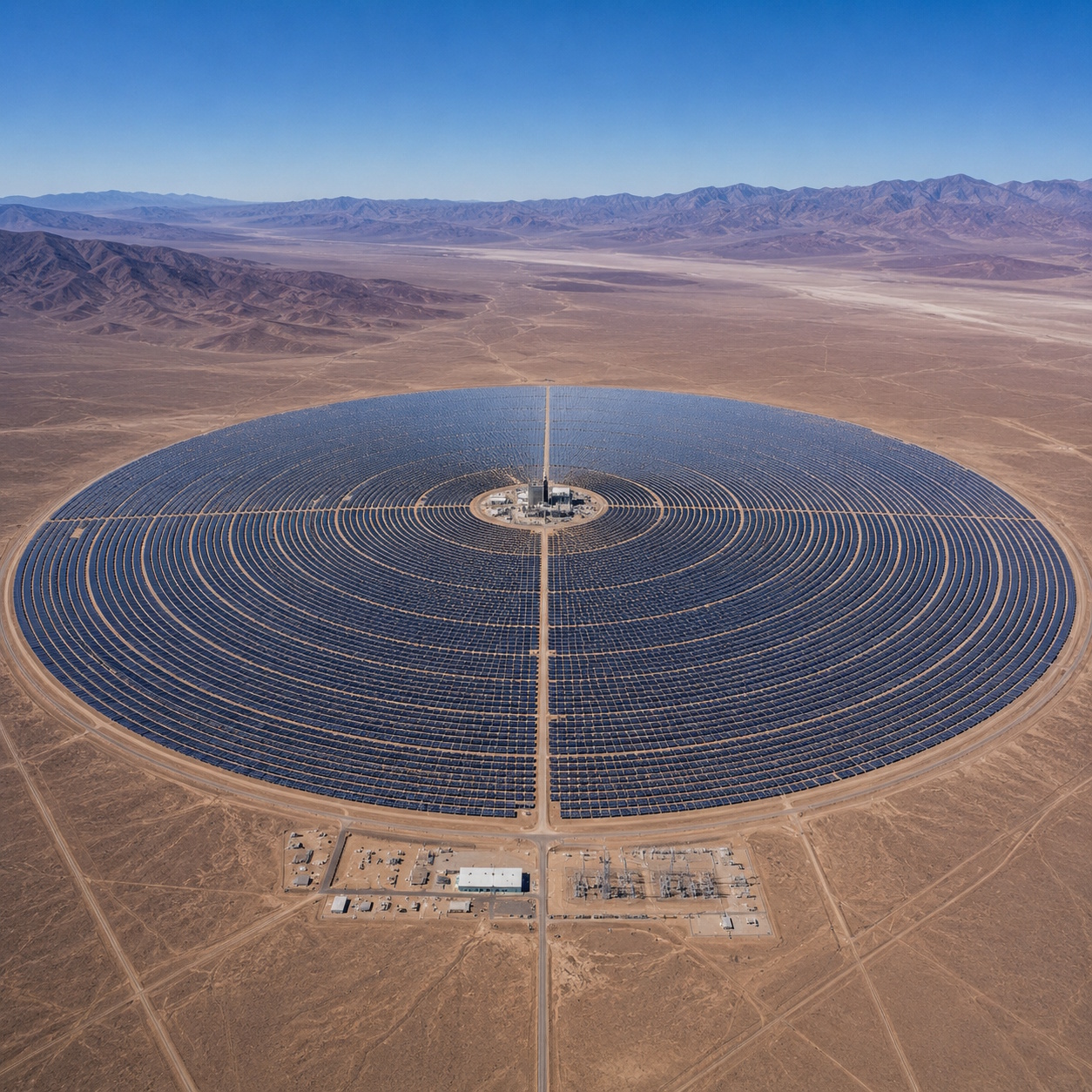
Copper mining operations do not pause at sunset. The extraction, crushing, flotation, smelting, and refining processes that together constitute a copper mine's energy demand run continuously, around the clock, every day of the year. Interrupting power supply to a copper concentrator or smelter is not simply inconvenient — it can damage equipment, contaminate product batches, and in the case of electrolytic refining, produce irreversible process failures. The energy demand profile of a copper mine is therefore among the most demanding of any industrial consumer: high, constant, and intolerant of the variability that solar generation introduces. This mismatch is the fundamental challenge that separates the Atacama's solar resource — which is extraordinary — from a complete solution to the copper industry's decarbonisation imperative. Three pathways exist for bridging the gap, each with distinct capital and timeline implications: first, battery energy storage systems (BESS), which can store daytime solar surplus and dispatch it through the overnight period, at an illustrative energy cost premium that is declining rapidly as lithium-ion battery prices fall; second, concentrating solar power (CSP) with thermal energy storage, of which the Cerro Dominador plant in the Atacama is the leading Chilean example — a 110 MW installation that stores heat in molten salt and can generate electricity continuously through the night without relying on battery chemistry; third, hybrid power purchase agreements (PPAs), in which mining operators contract a combination of solar, wind, and legacy thermal generation to maintain supply continuity while progressively displacing fossil fuel generation as the renewable capacity grows. Each pathway has advocates and precedents in the Atacama context; none has yet fully resolved the 24/7 supply requirement with purely renewable sources at the mine scale.
The Atacama's solar resource is large enough and cheap enough to power copper mining several times over — during the day. The investment variable that will determine how much value the green copper thesis actually delivers is not the solar resource but the storage infrastructure, and that is a capital allocation problem that the irradiance maps cannot resolve.
Lithium-ion BESS costs continue declining at the rates observed over the past decade, reaching price points by the late 2020s where overnight solar storage for continuous mining operations is economically competitive with fossil fuel peakers. CSP with molten-salt storage, validated by Cerro Dominador, scales along the Atacama corridor. Green copper commands a durable 5-15% market premium as downstream EV and renewables manufacturers face scope 3 pressure from their own customers.
BESS cost declines slow as lithium supply chains tighten under EV demand. CSP economics remain challenged relative to PV-plus-storage hybrids, limiting its replicability. Green copper premium remains inconsistently applied by commodity markets that struggle to verify and price embedded carbon at the tonne level. Water scarcity for panel cleaning and mining operations tightens further under climate-driven aridification.
The desert as both the problem and the solution
There is a structural irony at the centre of the Atacama thesis that no amount of analytical framing fully resolves. The copper embedded in the Atacama's geology is essential to the energy transition: without it, the motors that drive electric vehicles, the cables that carry grid electricity from offshore wind farms, and the connectors that link solar panels to inverters cannot exist in the quantities required. The energy transition that creates the demand for that copper is, simultaneously, the mechanism now being deployed to remove the carbon footprint from extracting it. The solar radiation that makes the Atacama the best solar site on Earth falls on the same landscape that hosts the copper mines most urgently in need of decarbonisation. This circularity is not a curiosity — it is, we argue, the core reason that the Atacama deserves a distinct analytical category in clean energy and materials investment frameworks, rather than being treated as simply a high-quality solar site with a convenient industrial anchor tenant. The framework implications are three: first, the correct unit of analysis for Atacama energy investment is not the solar plant in isolation but the integrated mining-energy system, because the value of the solar is partially a function of the premium it enables on the copper; second, the storage technology that closes the intermittency gap — whether BESS, CSP, or a hybrid — is the single highest-leverage capital allocation decision in the system, and the project economics of solar and mining both turn on it; third, the water constraint is the variable most consistently underweighted in published analyses of the Atacama energy thesis, and in a landscape that already measures annual rainfall in millimetres, the water demand of panel cleaning, mining process water, and any green hydrogen ambitions layered on top creates a resource competition that the irradiance maps do not capture.
The Atacama Desert is the driest place on Earth and the most solar-irradiated and one of the most copper-rich. These three superlatives are not independent facts about the same geography — they are a single investment thesis in three dimensions. The energy transition needs the copper; the copper needs the solar; the solar needs the storage; the storage needs the capital; and the capital needs a framework that holds all three dimensions simultaneously rather than pricing each in isolation. The desert provides the resource. The constraint, as always, is the system.
Sources: OpenWeather (openweather.co.uk); World Bank solar irradiance and energy data; International Copper Study Group production statistics; Cerro Dominador CSP project documentation; published LCOE research from IRENA and BloombergNEF referenced for context. This note is for informational purposes only and does not constitute investment advice.